






ATV & UTV Tracks for Ranching and Farming
Feed, fence, and check stock when the ground is frozen, drifted, or too soft to carry the tractor. The machine weighs a fraction of what the tractor does, and tracks spread that weight further still.
Why ranchers and farmers run tracks
The chores that cannot wait fall in the weeks when the ground will not carry the equipment that normally does them.
Take the light machine instead
USDA NRCS lists substituting lighter equipment for heavier among its compaction prevention methods. The lightest tractor in its published axle load table carries 7.7 tons on a single axle — 15,400 lb. If a side-by-side can carry the feed, the mineral, or the fence supplies, that is a far smaller load on ground you need to grow on.
Less weight per square inch
A tracked machine spreads the same weight over far more ground contact than a tire does, and NRCS lists increasing the surface area of contact with wider tires, duals or tracks among the ways to reduce topsoil compaction. That covers the surface. The subsoil is governed by axle load instead, which is why which machine you take matters more than what it rides on.
One person, before daylight
Chores do not wait for a second set of hands or for the ground to firm up. One person can feed, check water, and get back without hooking up the tractor or waiting on the ground to carry it.
Through the season
Winter chores
Feed and open water when the pasture is drifted
Daily feeding does not negotiate with snow depth, and the water is the other half of the trip. A tracked side-by-side carries hay, cake, mineral, and the axe or saw for a frozen tank across drifts that stop a wheeled machine at the gate. Deeply frozen ground carries a machine without deforming, which is why winter is the season to move what needs moving — a thin frozen crust over saturated soil is not the same thing, and it breaks under load and ruts to depth. It is usually the same machine and the same week that clears the yard and the lane, which our snow removal pages cover.
Late winter
Calving checks on ground that will ribbon
Calving puts you in the pasture several times a day, on soil that is at its most vulnerable. NRCS names soil moisture as the most important soil factor influencing the risk of soil compaction, and the ribbon test below takes about a minute to run. The lightest machine you own, on one planned route, is the version of that trip that costs you the least.
Growing season
Spot spraying and weed control
A sprayer on the back of a side-by-side reaches the draws, ditch banks, and fence lines a boom does not, and it gets there in the week the field itself is still too soft to carry the sprayer tractor. NRCS lists using high flotation rubber tracked equipment on planters and sprayers among its prevention methods, which is the same argument one size down. Watch the total load: Camso cautions that in loaded or working mode, at 100 kg and over, you should reduce speed significantly and be extra careful on rough terrain.
Late fall
Fence work and gathering before freeze-up
Posts, a driver, wire spools, and a tamping bar add up fast, and the fence line rarely follows the two-track. Fall rain, standing water in the swales, and the last pass through the far pastures all land in the same few weeks. Tracks carry that load through creek bottoms, sidehills, and soft draws where a loaded pickup would be stuck and a tractor would be too wide. The ruts you cut in November are still there in April.
When the ground is too wet to cross
USDA NRCS names soil moisture as the most important soil factor influencing the risk of soil compaction, and heavy wheel traffic and equipment load on wet soils as the main cause of it. The plastic limit is the moisture content where that turns: at or above it, significant soil compaction will occur; below it, minimal compaction will occur. NRCS publishes three field tests for finding that line with nothing but your hands, and two axle load thresholds for what happens once you are across it.
Three field tests for whether soil is too wet
These work best when the soil is moist to the touch below the surface. None of them needs a tool.
| Test | How to do it | What the result means |
|---|---|---|
| Ribbon test | Dig soil to four inches deep, grasp a handful, and squeeze it between the thumb and forefinger. | If the soil forms a ribbon, it is in condition for soil compaction to occur. |
| Hand rolling, for the plastic limit | Take about a tablespoon of soil and roll it between fingers or palms into a rod one eighth of an inch (3 mm) across, at 40 to 45 strokes per 30 seconds. | If it rolls into that rod, the soil is wetter than the plastic limit. If it crumbles first and will not make the rod, the soil is drier than the plastic limit. |
| Ball rule of thumb | Squeeze soil taken from the working depth into a ball in your hand. | If the soil makes a ball, NRCS calls it too wet to till. |
| Soil that forms neither | The soil is too granular to make a rod or a ribbon even when very moist. | NRCS says such soil is not very susceptible to compaction and smearing. |
| A ribbon, a rod, or a ball | Nothing left to test. | Staying off wet soils is one of the prevention methods NRCS lists. If the trip cannot wait, take the lightest machine you own down one planned route. |
The ribbon test is quoted from the NRCS document, which attributes it to Duiker. The hand-rolling procedure and the ball rule of thumb come from the same document. NRCS notes that determination of the plastic limit is independent of soil texture. Source: USDA NRCS 324.1, "Soil Compaction Symptoms, Causes, Correction & Prevention" (NRCS Michigan, July 2019)
What axle load does, and how deep
NRCS defines axle load as the total weight carried by one axle. Surface compaction of topsoil is determined by contact pressure; subsoil compaction is determined by axle load. Below are the two depth thresholds the document publishes, set against the lightest and heaviest entries in its own equipment table.
| Axle load on one axle | What NRCS reports |
|---|---|
| 5 tons (10,000 lb) | Creates surface compaction to about 12 inches deep. Normal tilling and planting with eight-row or greater equipment will exceed this; six-row equipment usually does not. |
| Greater than 10 tons (20,000 lb) | Creates subsurface compaction below 12 inches deep. |
| 7.7 tons (15,400 lb) | An MFWD tractor, the lightest entry in the NRCS equipment axle load table. |
| 12.7 tons (25,400 lb) | A 4WD tractor in the same table. |
| 35 to 40 tons (70,000 to 80,000 lb) | A full 1,200 bushel grain cart on one axle, the heaviest entry in the table. |
The tons figures and equipment labels are reproduced from the NRCS table, which credits Caterpillar (1996) and Pioneer (2019). The pound figures are a unit conversion at 2,000 lb per short ton and do not appear in the source; the source does not state whether its tons are short or metric, and short tons is the reading consistent with its cited sources. Real axle loads move with ballast, fill level, tire or track configuration, and hitch weight, so read these as representative of a class of machine rather than a specification for any one of them. Source: USDA NRCS 324.1, "Soil Compaction Symptoms, Causes, Correction & Prevention" (NRCS Michigan, July 2019)
No ATV or UTV appears anywhere in this source
NRCS 324.1 is written for farm equipment. Neither its axle load table nor its separate machine weight table lists a side-by-side, a quad, or anything close to one, so nothing here lets you read a figure for your own machine off it. Weigh what you actually drive, loaded the way you actually drive it, and use the NRCS figures for what they are: the scale of everything else that crosses the same ground.
Tracks change contact pressure, not axle load
NRCS lists increasing the surface area of contact by using wider tires, duals or tracks among the ways to reduce topsoil compaction, which is the half of the problem governed by contact pressure. It is equally direct about the other half: tracks for combines and grain carts will not eliminate the risk of subsoil compaction on heavy axle loads. Subsoil compaction is determined by axle load, so what protects the subsoil is bringing less weight, not spreading the same weight further. That is the whole argument for taking the side-by-side.
Most of the damage happens on the first trip across
NRCS reports that 80 to 90 percent of the wheel traffic occurs on the first pass, and cites Voorhees (1987) that about eighty percent of soil compaction is caused by the first trip over the field. It also reports that freezing and thawing has little effect on eliminating deep subsoil compaction below 12 inches, and that it can persist over winter. Ten trips down one planned lane cost far less than ten trips spread across a pasture, and deep compaction you do not cause is the only kind you never have to correct.
Which track system?
Which systems fit comes down to your year, make, and model. Which one is right comes down to whether the machine mostly feeds, mostly fences, or mostly tows.
ATV track systems
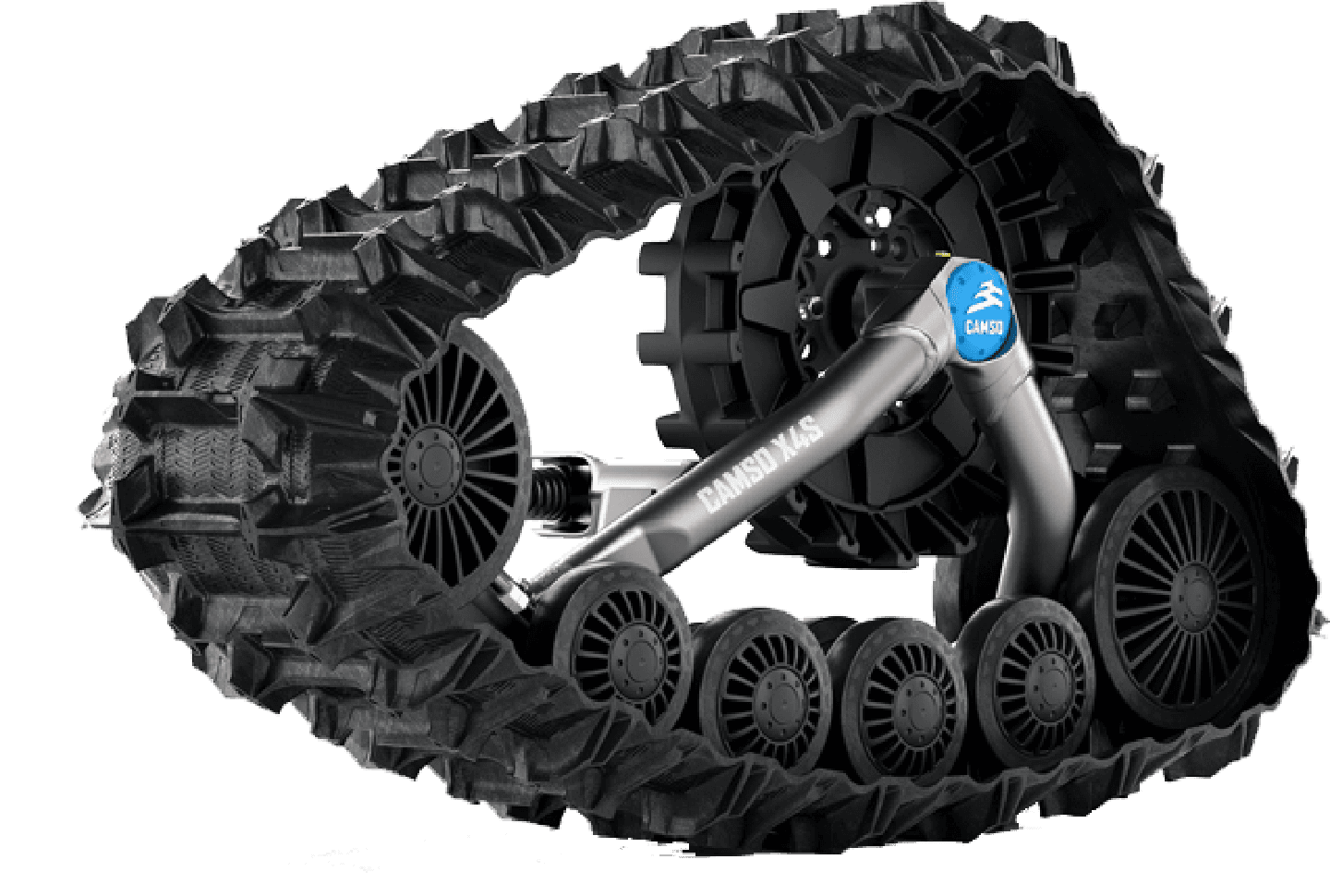
From $5,049
ATV & UTV
Buy this one if the tracks are going to stay on. It fits both ATVs and side-by-sides across 416 configurations and is built as an all-season system, so it carries from winter feeding through mud season and into summer pasture work.
See Camso X4S fitmentsUTV / side-by-side track systems
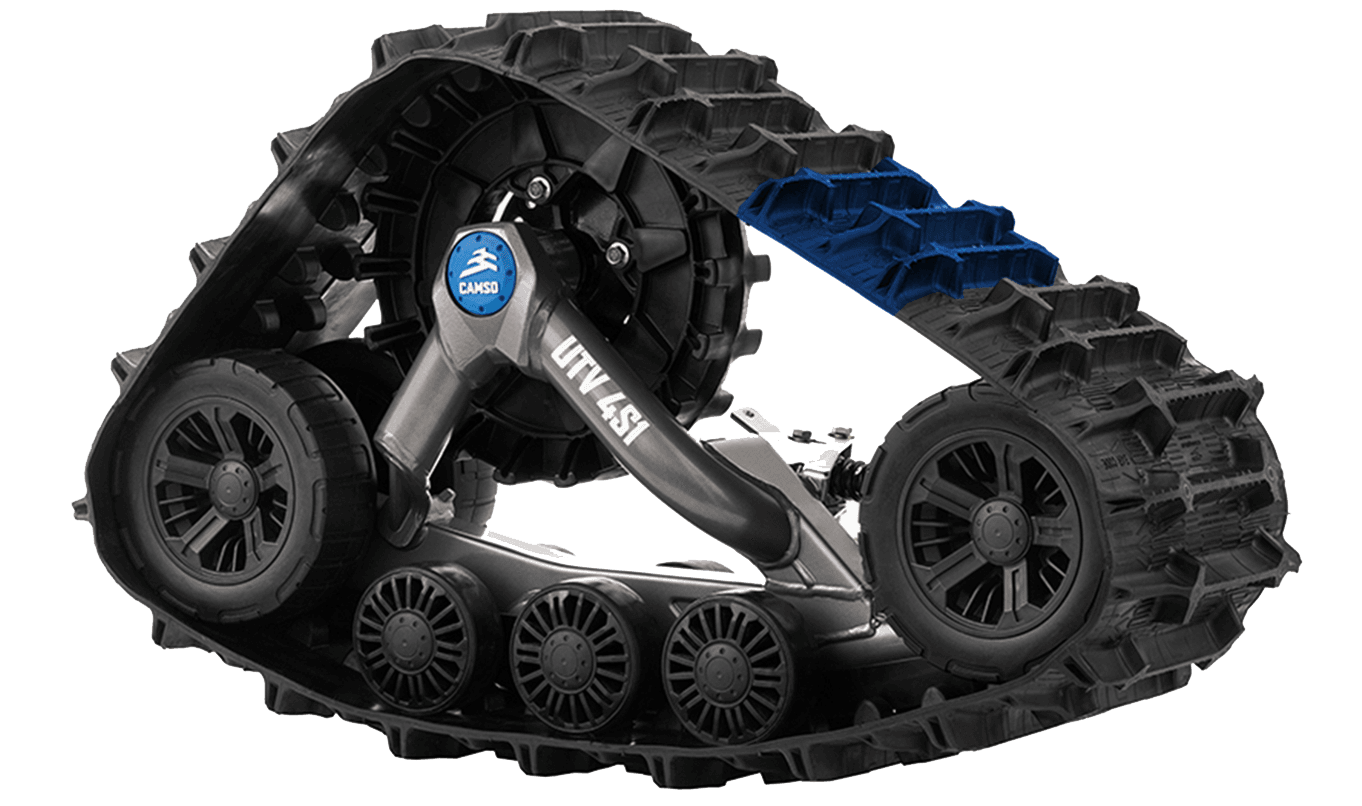
From $6,599
UTV, ATV & 4x4
The default for a working side-by-side. It covers UTV, ATV, and 4x4 platforms across 354 configurations, which matters on a place running more than one kind of machine, and Camso built it for winter first with fall and spring added afterward.
See Camso 4S1 fitments
From $5,995
UTV
The value pick if the ranch machine is a common full-size side-by-side. 524 UTV configurations is the broadest UTV fitment we carry, and it comes in under the 4S1.
See Kimpex WSS4 fitments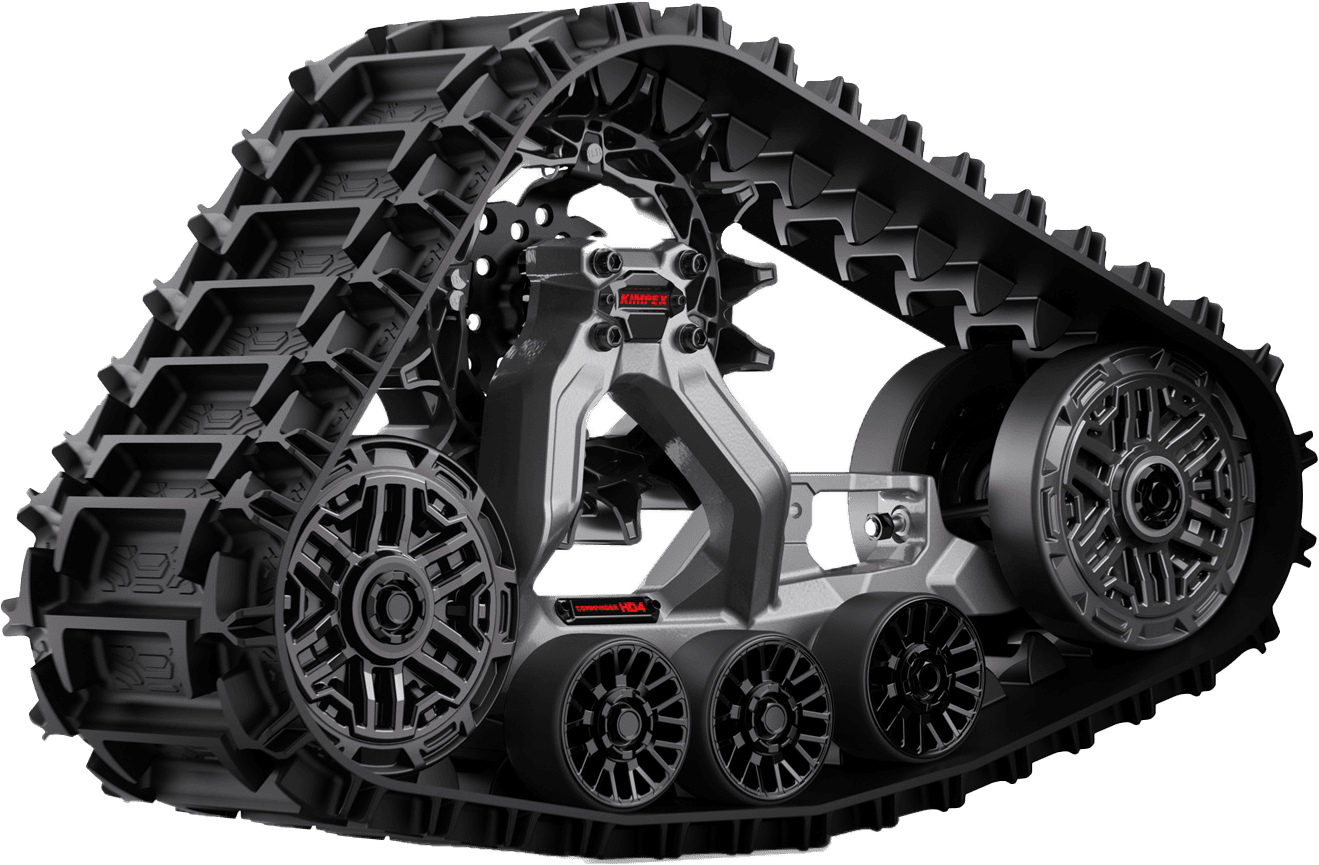
Kimpex HD4
Heavy DutyFrom $12,749
UTV under 4,000 lbs
Heavy-duty build for side-by-sides under 4,000 lbs. Worth the step up when the machine tows a feed trailer or a water tank most weeks rather than a few times a year.
See Kimpex HD4 fitmentsBefore winter chores start
Six things worth doing in the shop in October rather than in a pasture in January.
1. Run the ribbon test before you drive on it
Dig soil to four inches deep, take a handful, and squeeze it between thumb and forefinger. If it forms a ribbon, NRCS says the soil is in condition for soil compaction to occur. If it crumbles instead, you are looking at a much better day to be out there.
2. Take the lightest machine that will finish the job
NRCS lists substituting lighter equipment for heavier as a prevention method, and the lightest tractor in its axle load table still carries 7.7 tons — 15,400 lb — on one axle. Look at what the trip actually requires. Feed, mineral, fence supplies, and a saw usually fit in a cargo box.
3. Plan one route and stay in it
NRCS reports that 80 to 90 percent of the wheel traffic occurs on the first pass, and cites Voorhees (1987) that about eighty percent of soil compaction is caused by the first trip over the field. Ten trips down the same lane cost far less than ten trips spread across the pasture.
4. Swap and set up before the cold, not during it
Track rubber loses flexibility below freezing, and slack that was invisible in the shop becomes a thrown track in the pasture. Check track tension, alignment, and angle of attack, and torque the anchor bracket bolts in the shop where the tools are. Camso also suggests carrying wrenches and sockets, an axe, a shovel, a tow cable, a lifting jack, and an adjustable wrench on the machine. A dropped bolt in the yard is a delay. The same bolt two miles out in a blizzard is a different problem.
5. Know your slope rule before you need it
Read the slope limit in your machine's operator manual and treat it as a ceiling rather than a target. That figure was set for the machine on tires: Camso states that installing a track system increases ground clearance, changes the center of gravity, and increases the vehicle's width and weight, and that these parameters will change how the machine drives. OSHA's ATV and UTV guidance, published in its oil and gas well drilling and servicing eTool, is to avoid traveling across a slope, to travel straight up or down instead, and to choose a route with the least grade. If you are unsure of the machine on a grade, get off and walk the route.
6. Leave the route with somebody, and start with fuel
Feeding routes run through country with no phone signal and no traffic. Tell someone which pastures you are hitting and when you expect to be back, and start the day with more fuel than the loop needs. Tracks raise fuel consumption, and backing out of a drift costs more than driving through one.
Common questions
Do tracks reduce soil compaction on pasture and hay ground?
They address one half of the problem. USDA NRCS states that surface compaction of topsoil is determined by contact pressure and that subsoil compaction is determined by axle load. Tracks spread the same weight over much more surface area, which lowers contact pressure, and NRCS lists tracks among the ways to reduce topsoil compaction. It is blunt about the other half: tracks for combines and grain carts will not eliminate the risk of subsoil compaction on heavy axle loads. What protects the subsoil is a lower axle load, and that is where a side-by-side wins against a tractor no matter what either one is running on. Check your machine's published dry weight, then add what you load into it. The surface half of this argument — ruts, water channeling, and what a skid trail looks like after a wet week — is where our land management guide picks it up.
Do tracks rut a wet field less than tires?
Less, not never. Ruts form when soil is wet enough to deform, and NRCS names soil moisture as the most important soil factor influencing the risk of soil compaction. Tracks help because the load is carried across far more surface area, so the machine sinks less and shears less sod. Timing is still the reliable control. Use the NRCS ribbon test above: if soil dug from four inches down forms a ribbon when squeezed between thumb and forefinger, it is in condition to compact, and the right call is usually to wait, or to take the lightest machine you own down a single planned route.
Can a tracked side-by-side replace the tractor for winter feeding?
For some feeding jobs, yes, and that substitution is the strongest argument for tracks on a ranch — NRCS lists substituting lighter equipment for heavier among its compaction prevention methods. What does not change is what the machine is rated to carry. Your cargo box rating and towing rating come from the vehicle manufacturer, and installing tracks raises neither one; Camso states plainly that you must never exceed the cargo and tow capacity specified by your vehicle manufacturer, on any type of terrain. What tracks change is how much of that rating you can actually use, because on snow and thawing pasture a wheeled machine runs out of traction well before it runs out of capacity. Weigh the hay, cake, or mineral you plan to move and check it against the operator manual. If the load is a round bale or a full water tank, that is still tractor work.
Can I run tracks on the gravel road between pastures?
Short crossings between pastures are normal and hard to avoid. Extended running on hard surfaces is what wears a system out. Camso cautions against running under dry and clean conditions, giving asphalt and a hay or straw field as its own examples, and notes that a track system considerably reduces the top speed and can falsify the speedometer, so the machine is moving slower than the dial reads. The Camso UTV 4S1 is built for vehicles running a maximum real speed of 40 km/h, roughly 25 mph, and Camso warns that exceeding that on dry terrain can cause premature wear or major breakdowns that normal warranty will not cover. Check what your state and county allow as well: road rules for ATVs and UTVs vary, and a track system does not change them.
How long does it take to swap between tires and tracks?
It depends on the system and the machine, and the honest answer is that the first swap takes far longer than every one after it. Plan the first one for a day in the shop with the install kit, the instructions, and a lifting jack, rather than for the morning of the first storm. Most operations settle into swapping twice a year on the same two weekends. Call us with your year, make, and model and we will tell you what the install actually involves on your machine before you buy.
Does a track system change how the machine sits on a sidehill?
Yes, and it is worth knowing before your first sidehill rather than during it. Camso states in its owner documentation that installing a track system increases ground clearance, changes the center of gravity, and increases the vehicle's width and weight, and that these parameters will effectively change the driving characteristics of the machine. The slope figure in your operator manual was set with the machine on tires, so treat it as a ceiling that tracks do not raise. OSHA's ATV and UTV guidance, published in its oil and gas well drilling and servicing eTool, is to avoid traveling across a slope, to travel straight up or down whenever possible, and to choose a route with the least grade. If you are unsure of the machine's capability on a grade, get off and walk the route first.
Which track system fits a ranch or farm machine?
It depends on the machine and on the load. For a full-size side-by-side doing feeding and hauling, the Camso 4S1 covers UTV, ATV, and 4x4 platforms across 354 configurations, which matters on a place running more than one kind of machine. The Kimpex WSS4 covers 524 UTV configurations, the broadest UTV fitment we carry, and it usually costs less than the 4S1. The Camso X4S is the one to look at if the tracks are going to stay on past winter. The Kimpex HD4 is the heavy-duty option for side-by-sides under 4,000 lbs. The Camso ENDUR is heavier duty still, but it is currently pre-order with only four fitments, so call before you plan a season around it. Fitment comes down to your exact year, make, and model, and every system needs the matching install kit — use our find-what-fits tool or call and we will confirm the right kit for your machine before you buy.
Same machine, other jobs
More from the field
Not sure what fits your machine?
Tell us what you drive and how you use it. We will confirm the right track system and install kit before you spend a dollar.
(866)243-8359