






ATV & UTV Tracks for Backcountry Riding
Ride the country past where the maintained trail ends. Deep snow, spring breakup, and terrain a long way from the nearest tow truck.
Where a tracked machine earns the trip
Four windows in the year when a track system is the only vehicle in the shed that gets you out and back.
Float instead of dig
Camso lists exactly what installing a track system changes: it increases ground clearance, changes the center of gravity, adds width and weight, and reduces ground pressure. That last one is the reason to be out there at all. In deep snow, muskeg, and saturated ground, that spread-out footprint is what keeps a machine moving where a tire digs in and stops.
The ride out is the one that counts
Twenty miles in, a stuck machine is not an inconvenience. It is the trip. Camso's own advice on getting traction is blunt: generally, the slower you go, the better the traction will be. Steady is what gets a loaded machine home under its own power. Our hunting page covers the same problem from the other end, recovery a long way from the road.
Slower, and further
Expect a lower top speed and higher fuel consumption than tires. What you get back is ground you could not otherwise cross, which is the trade most riders are making on purpose.
Through the season
Deep winter
Cabins and country with no plowed road
A cabin road nobody has plowed since December is where a wheeled machine turns around and a tracked one keeps going. This is also the trip with the least margin: shorter daylight, colder air, and nobody else on the road to notice you did not come back. Plan the return leg for the temperature at four in the afternoon, not the temperature at noon.
Spring breakup
Frost coming out and creeks running high
Frost coming out of the ground turns two-track into something a truck cannot enter and a quad on tires cannot leave. This is the several-week window when a track system is the only thing that moves. Two cautions come with it. Many public roads and trails close during breakup to protect the surface, so check with the local land manager before you go. And the creek that was ankle deep in February runs high and fast now — a track system does nothing about moving water, and that is a turnaround rather than a crossing.
Summer
Muskeg, bog, and beaver country
Wet ground that never dries out is flotation country year round. Camso rates the X4S first and foremost for traction and flotation in extreme terrain such as deep snow and mud, and the break-in itself is specified for lubricated surfaces: water, mud, snow, soft soil, sand, or dust. Sand is on that list but counts as an abrasive condition, which shortens track-tension inspection from every 40 hours in normal winter conditions to every 25. Our fishing page covers the same backcountry lakes and beaver flowages from the angler's side.
Late fall
The gap between last tires and first grooming
There is a stretch every year with too much snow for tires and not enough base for a groomed trail or a sled. Nobody has been down the route yet, so there is no packed track to follow and no traffic behind you. Tracks cover that gap. It is worth remembering that anything you cross going in you have to cross again coming out, on a machine that is now carrying less fuel.
Wind chill at riding speed
Camso's X4S owner's manual sets the maximum real operating speed for a tracked ATV or side-by-side at 40 km/h, about 25 mph. On an open machine, that travel speed is also wind across your face. The National Weather Service wind chill chart is the federal standard for what moving air costs you, and it is published for someone standing still. The table below reads two of its rows side by side: stopped in a light breeze, and moving at the manufacturer's own maximum. Look at the 0°F row. Stopped in a 10 mph wind you are at -16°F, which the chart leaves off its shaded frostbite bands entirely. Riding at 25 mph you are at -24°F, squarely in the 30-minute band.
| Air temperature | Wind chill stopped (10 mph wind) | Wind chill riding at 25 mph | Frostbite on exposed skin, riding at 25 mph |
|---|---|---|---|
| 20°F | 9°F | 3°F | Not shaded on NWS chart |
| 15°F | 3°F | -4°F | Not shaded on NWS chart |
| 10°F | -4°F | -11°F | Not shaded on NWS chart |
| 5°F | -10°F | -17°F | Not shaded on NWS chart |
| 0°F | -16°F | -24°F | 30 minutes |
| -5°F | -22°F | -31°F | 30 minutes |
| -10°F | -28°F | -37°F | 10 minutes |
| -15°F | -35°F | -44°F | 10 minutes |
| -20°F | -41°F | -51°F | 10 minutes |
| -25°F | -47°F | -58°F | 10 minutes |
| -30°F | -53°F | -64°F | 5 minutes |
Both wind chill columns are read directly off the NWS chart at a published row and column; nothing is interpolated or averaged. The right-hand column reproduces the shaded bands the chart prints on its 25 mph row. "Not shaded on NWS chart" means the chart assigns that cell no frostbite time — it does not mean exposed skin is safe there, and it says nothing about hypothermia. Source: NOAA National Weather Service, Wind Chill Chart (effective 11/01/2001)
Riding speed stacks on top of the wind
The chart describes a person standing still in moving air. Using its 25 mph row for a machine travelling 25 mph is an extension the National Weather Service does not make, and it runs in one direction: your speed adds to the wind already blowing. On a day with a 20 mph wind, riding into it puts something near 45 mph across your face, which is a colder row than anything shown here. Read the 25 mph column as a floor rather than a ceiling. A tailwind subtracts, and terrain usually keeps you well under the maximum anyway, so treat the two wind chill columns as a range rather than a fixed value.
The limits of the wind chill index
Per the National Weather Service (weather.gov/safety/cold-wind-chill-chart), the wind chill temperature is defined only for air temperatures at or below 50°F and wind speeds above 3 mph, it calculates wind speed at an average height of five feet, and it assumes no impact from the sun. It does not account for wet skin, wet clothing, exertion, altitude, or a prior cold injury, all of which make real exposure worse. The NWS also notes that frostbite requires the actual air temperature near the skin to be below freezing, not the wind chill alone, which matters for the four rows here at 5°F and warmer. The 25 mph column corresponds to Camso's published maximum real speed for the X4S system; other systems and other machines differ.
Frostbite times are not the whole cold risk
The bands describe skin, not core temperature. Hypothermia develops at wind chills well above the coldest row in this table. The exposure clock also runs fastest during a breakdown, when you have stopped generating heat and have not stopped losing it — which is the scenario a remote trip has to be planned around, not the scenario where everything works. Carry a full change of insulating layers in a dry bag, and a way to make heat that does not depend on the machine running.
Which track system?
Four systems suited to covering ground. Which one is right depends on what you drive and how far from the truck you intend to get.
ATV track systems
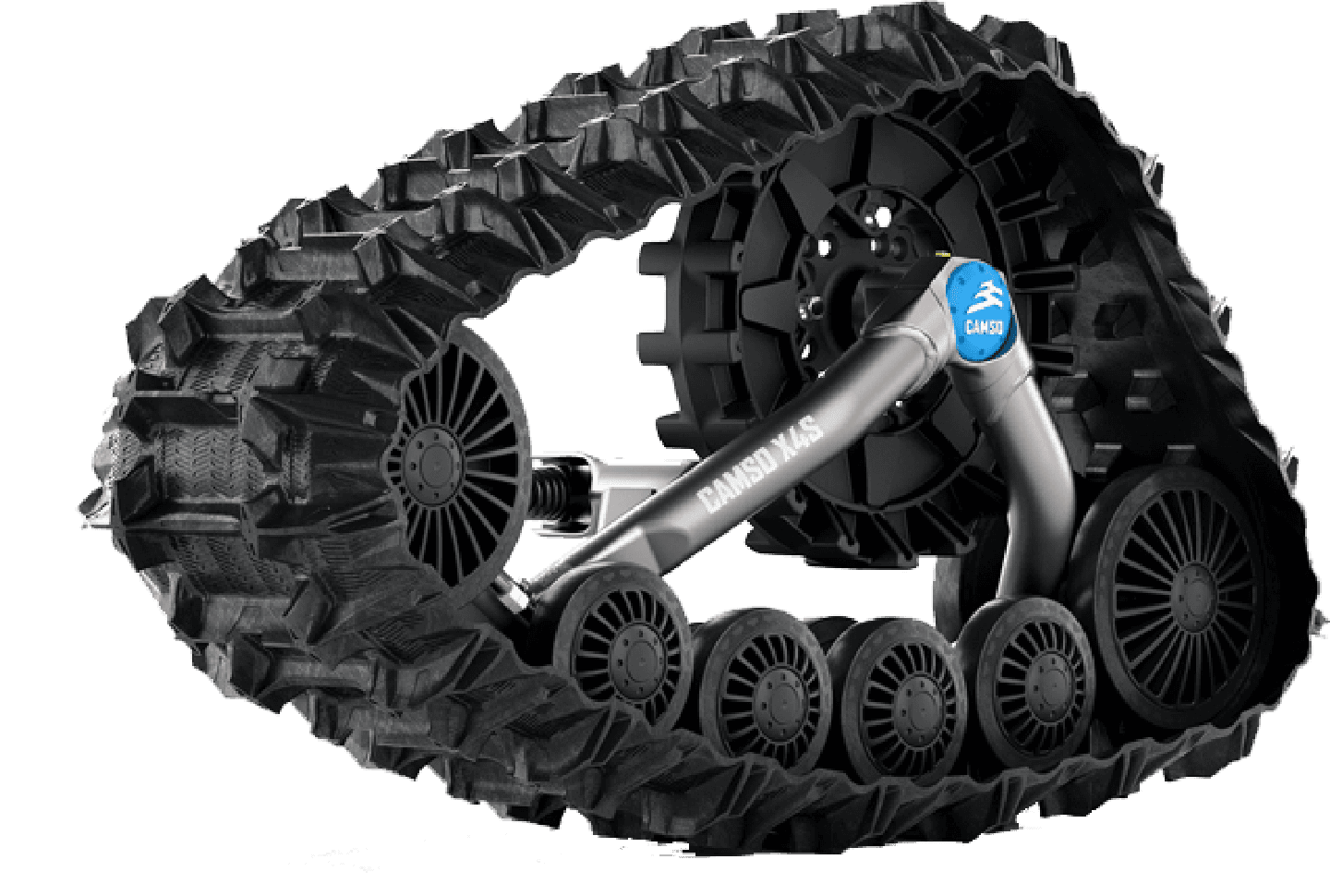
From $5,049
ATV & UTV
One system across both platforms and the whole calendar, spanning 416 ATV and side-by-side configurations. Camso rates it first for traction and flotation in extreme terrain such as deep snow and mud, which is the specification that matters when the route has not been broken yet.
See Camso X4S fitments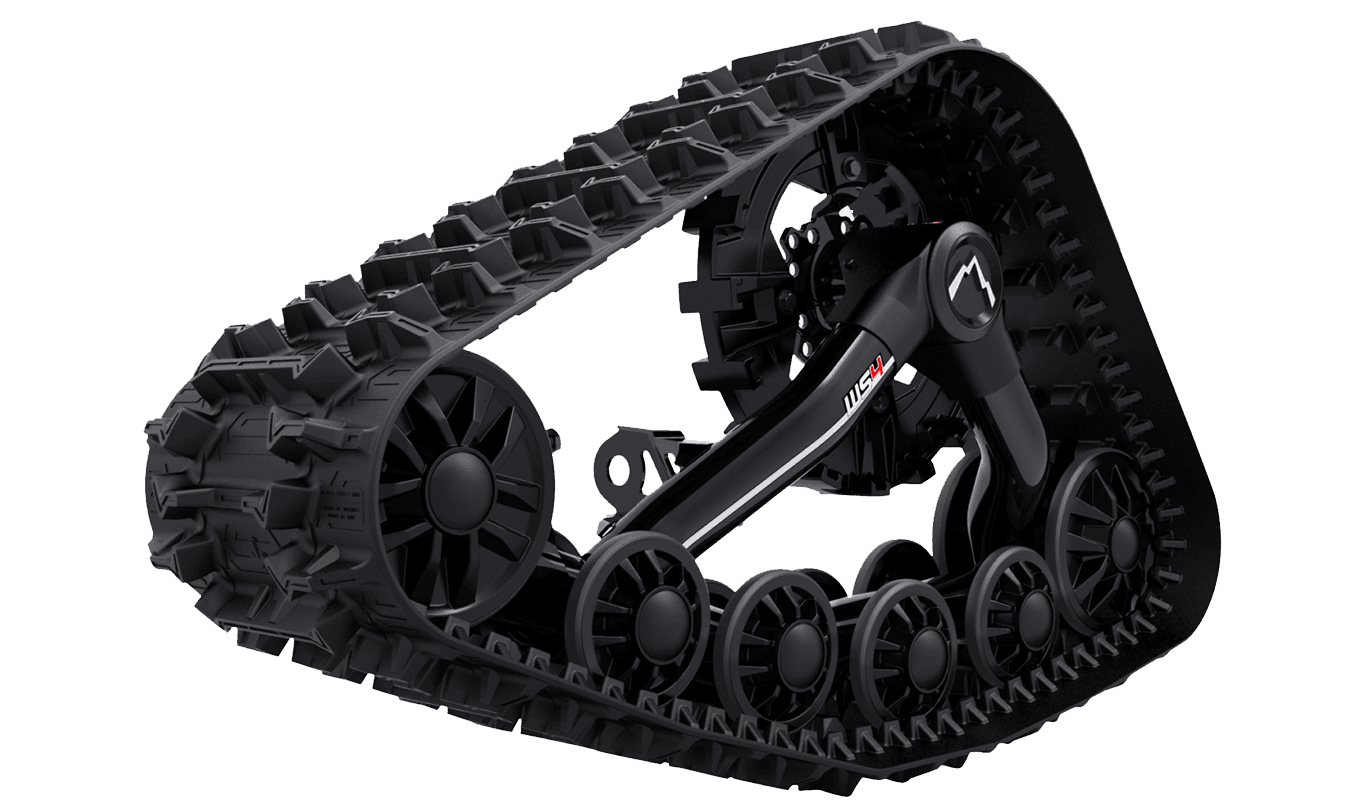
From $4,845
ATV
The widest ATV coverage in our catalog at 733 machine configurations, so it is the system most likely to exist for an ordinary quad. A sensible first set of tracks for a rider whose trips are long but whose machine is not exotic.
See Kimpex WS4 fitmentsUTV / side-by-side track systems
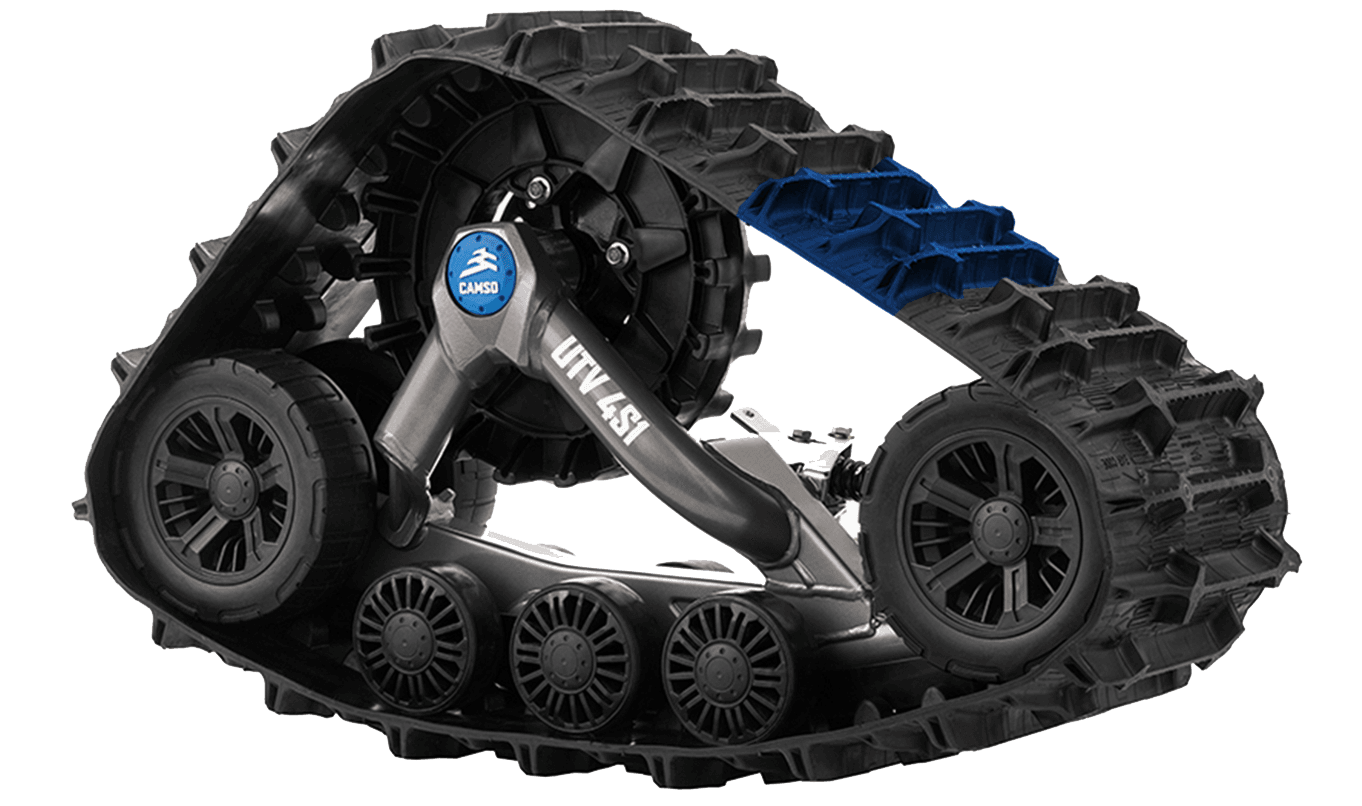
From $6,599
UTV, ATV & 4x4
The side-by-side answer when the trip runs several days and carries camp, fuel, and a passenger. Its 354 configurations span UTV, ATV, and 4x4, which matters when the machine you take to the backcountry is not the one you take to work.
See Camso 4S1 fitments
From $5,995
UTV
Broad side-by-side coverage at 524 configurations. The practical pick for a group that wants a second tracked machine along for redundancy on a remote trip.
See Kimpex WSS4 fitmentsBefore a remote trip
Every item here matters more the further from the truck you intend to get.
1. Budget the day in daylight hours
Camso caps the X4S at 40 km/h of real speed, roughly 25 mph, and notes that reads as about 70 km/h on the speedometer. The manual also states that a track system affects speedometer and trip meter readings by approximately 35 percent, depending on the ratio between sprocket and tire size. Both your speed and your odometer read high on tracks. Plan the day in hours of daylight rather than in miles, set a turnaround time before you leave, and carry more fuel than the same loop takes on tires.
2. Finish the break-in before the trip
Camso specifies a break-in period of 4 hours or 80 kilometers, with speed held down in stages and an inspection at each hour, and it must be done in a lubricated environment such as water, mud, snow, soft soil, sand, or dust. Running on dry, clean surfaces during break-in is specifically warned against, with asphalt and a hay or straw field given as the examples. A bad break-in shows up as smoke, an odor of burned rubber, and plastic deposits on the sprocket or frame. That is not a discovery to make on day one, forty miles from the truck.
3. Carry Camso's excursion kit
Camso's excursion list is specific: 13, 14, 15, 16, 17, and 19 mm wrenches and sockets, an axe, a shovel, a tow cable, a lifting jack, and an adjustable wrench. Treat it as a trail-repair loadout rather than a complete tool list for the system — the manual calls for a 30 mm wrench elsewhere, to rotate the steering limiter support plate when setting angle of attack, and that size is not on the excursion list.
4. Carry spares, and check hardware at every stop
The last item on Camso's remote-terrain list is spare parts, and it is the one people skip. Carry replacement fasteners for the sprocket and the anchor bracket, thread locker, and whatever else your particular kit's hardware uses, and know how the pieces go back together before you need to do it in the dark with cold hands. A dropped sprocket bolt is a ten-minute stop at the trailhead and a serious problem fifteen miles out. Walk around the machine at every stop rather than at the end of the day: the first bolt to back out is what lets the next few go.
5. Dress for the wind you make
Read the 25 mph row in the table above as a floor, not a ceiling — riding speed stacks on top of the wind already blowing, so on a windy day headed into it, look up a faster row than 25 mph. At 0°F, sitting still in a 10 mph wind reads -16°F and sits outside the chart's shaded frostbite bands entirely, while riding at 25 mph reads -24°F and lands in the 30-minute band. Take the air temperature down to -30°F and riding puts you at -64°F, in the 5-minute band. Cover every square inch of skin and carry a full change of insulating layers in a dry bag.
6. Leave a plan, and carry a radio that needs no tower
For an excursion on unknown or remote terrain, Camso calls for a cellular or satellite phone, a first aid kit, and spare parts. Treat cell coverage as absent unless you have personally used a phone at that spot. Leave your route, access point, and expected return time with someone who is not on the trip, and tell them specifically what to do and who to call if you are late.
Common questions
How fast can I actually go on tracks?
Camso's X4S owner's manual sets the maximum real speed at 40 km/h, about 25 mph, and states that this shows as roughly 70 km/h on the speedometer, near 43 mph indicated. Exceeding that speed when terrain conditions are dry can cause premature wear or major breakdowns, and the manual says breakage due to excessive speed is not covered under normal warranty. It separately notes that speedometer and trip meter readings are affected by approximately 35 percent, depending on the ratio between sprocket and tire size. The practical takeaway is that both your speed and your mileage read high on tracks, so plan by time rather than by distance.
How much fuel range do I lose on tracks?
Expect less range, and plan for it rather than measure it from the dash. A track system adds weight and rolling resistance, and real operating speed is capped near 25 mph, so the engine is working harder for every mile of ground covered. We do not publish a percentage because the honest figure depends on the machine, the kit, the snow, and what you are dragging — a single number across all of that would be a guess. Two things make it plannable. First, Camso states that a track system affects trip meter readings by approximately 35 percent, so the odometer overstates how far you have actually travelled, and fuel economy worked out from that reading looks better than it is. Second, run the first trip of the season as an out-and-back on a route you could walk, and note what the tank really does. Then plan the loop by hours and fuel rather than by distance, and carry the return leg on the assumption that the return leg is the slower one.
Can I trailer the machine with the tracks installed?
Usually, but measure before you load. Camso lists what installing a system changes, and three of those four items matter on a trailer: ground clearance goes up, the vehicle's width and weight go up, and the center of gravity changes. Wider can mean the machine no longer clears fenders or uprights that it cleared on tires, so measure the outside width at the widest point of the track system rather than at the tires it replaced. Taller means a higher center of gravity going up the ramp and a different clearance at the crest where the ramp meets the deck, which is where a long machine hangs up — use the longest ramps you have, because ramp angle is the whole problem, and load slowly and straight with someone watching the crest. Heavier means checking the trailer's rating with the tracks counted in. For tie-downs, apply Camso's own rule for a tow cable, which must be attached to the vehicle's frame and never to the track system: run your straps to the machine's frame tie-down points. If you are close on width or on ramp length, call us with your trailer dimensions and the kit you are considering before you buy either one.
Can I ride a tracked ATV on a groomed snowmobile trail?
Check first, and assume the answer is no until someone with authority over that trail tells you otherwise. Groomed trails are generally maintained by a club or a state program under rules written for snowmobiles, and whether a tracked ATV or side-by-side qualifies is answered differently in different states — sometimes differently on different trail systems within one state. Some states allow tracked machines on designated trails with a registration or trail permit, some restrict grooming-funded corridors to registered snowmobiles only, and some leave it to the club or the landowner whose ground the trail crosses. Width is a separate question, since a side-by-side on tracks is wider than many trails were cut for. Ask the state agency that administers the trail program and the local club, in writing where you can, and carry whatever permit they name. Installing a track system does not change what a trail rule says about your machine.
How much ground clearance do I gain with tracks installed?
More than on tires, but the amount is specific to the kit and the machine, so we would rather look it up with you than quote a number that is wrong for your setup. Camso lists it as one of four things installing a system changes: ground clearance increases, the center of gravity changes, width and weight increase, and ground pressure decreases. Two of those work against you, and it is worth knowing which — a higher center of gravity on a machine that is also heavier is not the combination you want on a sidehill. On obstacles, Camso advises against attempting to drive over anything taller than 30 cm, about 12 inches, such as a tree trunk, stump, or large rock, and suggests placing a log or rock alongside it to reduce the effective height if it has to be crossed. It separately warns against driving over a steep ridge or object that could lodge between the front and rear track systems and immobilize the machine, where the best option is to go around. That 12-inch figure is a decision rule for the moment you are standing at the obstacle, not something you can scout from a map or satellite image. What you can plan in advance is bypass routes and the extra time they cost.
Do tracks make a rough trail more comfortable?
Not by themselves, and it is worth being straight about it. Camso's manual states that track systems installed on a vehicle do not have the same absorption capacity as tires, and instructs riders to reduce speed at all times. A track system is an access tool and not a suspension upgrade. What it gives you over a long day is a steady pace across ground that would otherwise mean repeated stops, digging, and winching, and that usually matters more to how you feel at the end of the day than ride quality over any single bump.
Which track system fits my machine for long, remote trips?
Start with what you drive, then confirm the kit. On an ATV, the Kimpex WS4 covers 733 machine configurations, which makes it the system most likely to exist for the quad already in your shed. The Camso X4S is the pick if you want one system that spans an ATV and a side-by-side and works across the whole calendar. For a side-by-side carrying camp and passengers, the Camso 4S1 is the workhorse, and the Kimpex WSS4 covers 524 UTV configurations. The heavy-duty systems, the Kimpex HD4 and the pre-order Camso ENDUR, are built for sustained hauling rather than for covering distance, and are usually more system than a backcountry rider needs. Every one of these is fitment-specific, so the shortlist above narrows only once we know the year, make, and model you ride, and the install kit that mates the system to your hubs is part of the order rather than an accessory to it. Run the machine through our find-what-fits tool, or call and we will work through it with you before you commit to a kit.
Same machine, other jobs
More from the field
Watch
This is Boondocking ATV Tracks
Camso Tracks in Deep Snow ATV tracks
ATV and QUAD Tracks - Deep Snow Riding
Not sure what fits your machine?
Tell us what you drive and how you use it. We will confirm the right track system and install kit before you spend a dollar.
(866)243-8359