






ATV & UTV Tracks for Hunting
Reach the stand when the two-track is under water. Bring the animal out when it drops a half mile from the nearest road.
Where hunting access breaks down
Four points in a season where the ground, rather than the hunting, decides how the day ends.
Reach ground the trail does not
Flotation is what moves a machine across saturated soil, boggy ground, and unbroken snow. It is not a substitute for depth: tracks do not float a machine in open water and they do not make thin ice safe, so a beaver flowage or a creek crossing still has to be sounded out on foot first. What tracks buy you is the route you want rather than the one hard-packed trail on the property.
Bring the animal out whole
A mature whitetail with a 40 to 44 inch chest girth field-dresses at 144 to 198 lbs per the Pennsylvania Game Commission chart below. Traction is what turns engine torque into actual movement, and on wet leaves and snow it decides whether you load the animal once or quarter it where it lies.
One trip in, one trip out
A machine that does not bog down makes one pass instead of three. That means less walking through bedding cover before shooting light, and one load out instead of two trips on your back.
Through the season
Late summer
Reaching plots the truck cannot
The plots worth having are the ones at the back of the property, and the access to them is soft for most of the summer. Tracks are how the seed, the lime, and the stand sections get to the far corner the day after a rain instead of the following week. The preparation side of that work — discing, spraying, seedbed, and which implements a tracked machine will pull — belongs to our land management guide, which covers food plot and trail work in more depth than this page does.
Early season
Wet ground and standing water
October rain closes the low ground first. The soft margins around creek bottoms, flooded timber, and beaver flowage hold the birds and the undisturbed deer, and they are the first places tires quit. Tracks get you through the mud on the way in; they do not get you through standing water of unknown depth, and that judgment call is still yours to make on foot. Once those same ponds and sloughs freeze, the question stops being depth and becomes thickness — the ice thickness guidelines on our fishing page are the ones to work from, and a tracked machine does not earn you thinner ice.
The rut
Recovery after dark
Mature bucks move at last light and go down after it. A recovery at nine at night on unfamiliar ground is the trip where the machine either works or the animal waits until morning. Pick the route out and put the straps on the rack before you climb into the stand, not after.
Late season
Western country and a long haul back
Snow-covered ground at elevation, quartered meat, and multiple trips back to a trailhead. A tracked side-by-side is the difference between packing an elk out over two days and driving to it — where the travel plan for that unit allows driving to it at all, which is a question to settle before the hunt rather than at the carcass.
What that deer actually weighs
Weight is the number that decides whether you drag it, cart it, or go get the machine. You can estimate it in the field with a tape measure. Run the tape around the chest just behind the front legs, read the girth, and find the row below. The Pennsylvania Game Commission and Penn State University built this conversion from measured animals, and it is reproduced here in full. The highlighted rows begin at 40 inches of girth, where field-dressed weight passes 144 lbs and a solo drag over uneven ground stops being a realistic plan.
Deer weight by chest girth
| Chest girth (in.) | Live weight (lbs) | Field dressed (lbs) | Edible meat (lbs) |
|---|---|---|---|
| 20 | 37 | 26 | 18 |
| 21 | 41 | 29 | 20 |
| 22 | 45 | 32 | 22 |
| 23 | 50 | 35 | 24 |
| 24 | 55 | 38 | 27 |
| 25 | 61 | 43 | 29 |
| 26 | 66 | 49 | 30 |
| 27 | 71 | 53 | 31 |
| 28 | 77 | 59 | 34 |
| 29 | 82 | 64 | 36 |
| 30 | 90 | 70 | 39 |
| 31 | 98 | 74 | 42 |
| 32 | 102 | 80 | 45 |
| 33 | 110 | 87 | 50 |
| 34 | 118 | 91 | 54 |
| 35 | 126 | 99 | 57 |
| 36 | 135 | 104 | 61 |
| 37 | 146 | 115 | 66 |
| 38 | 157 | 126 | 71 |
| 39 | 169 | 135 | 74 |
| 40 | 182 | 144 | 80 |
| 41 | 195 | 156 | 88 |
| 42 | 210 | 170 | 94 |
| 43 | 228 | 182 | 103 |
| 44 | 244 | 198 | 110 |
| 45 | 267 | 214 | 120 |
| 46 | 290 | 233 | 130 |
| 47 | 310 | 251 | 139 |
| 48 | 340 | 272 | 153 |
Chest girth is measured just behind the front legs. Every published row is reproduced here. Highlighted rows are the animals heavy enough that most hunters go get the machine rather than drag. Source: Pennsylvania Game Commission, with the Penn State University Department of Dairy and Animal Science
This chart is white-tailed deer, and it is an estimate
The chart was built from Pennsylvania animals. Body size varies by region, age, sex, and time of year. A northern buck in early November can carry weight this chart does not predict, and the same buck three weeks later, run down by the rut, can fall well under it. Girth also shifts with how hard the tape is pulled and how the animal is lying. Field-dressed weight depends on how completely the animal was dressed, and edible meat depends on shot placement and how much has to be trimmed away. Treat any line here as an estimate, not a scale reading. It does not transfer to other species: for mule deer, Wyoming Game and Fish puts the average buck at 150 to 250 lbs live, with dressed weights normally 120 to 190 lbs, and for moose, Alaska Department of Fish and Game states that a 1,600 lb bull dresses out at about 950 lbs and yields roughly 500 lbs of meat.
Motorized retrieval is restricted on much of the public land you hunt
In designated Wilderness, the Wilderness Act at 16 U.S.C. 1133(c) prohibits motor vehicles, motorized equipment, and any other form of mechanical transport. That prohibition has been read to cover wheeled game carts as well as machines: a Forest Service order under 36 CFR 261.57(h) names game carts explicitly across Rocky Mountain Region Wilderness. Outside Wilderness, national forest and BLM travel management under 36 CFR Part 212 generally confines motorized travel to designated routes shown on a motor vehicle use map. Some units publish a narrow big-game retrieval exception with a distance limit and a season; many publish none. Installing tracks does not change any of this. Read the current motor vehicle use map and the state game agency regulations for your unit before you plan a hunt around driving to the animal.
Which track system?
Hunting is usually a first set of tracks on a machine you already own, so start from what fits your quad or side-by-side and work up only if you are moving animals and feed all year.
ATV track systems
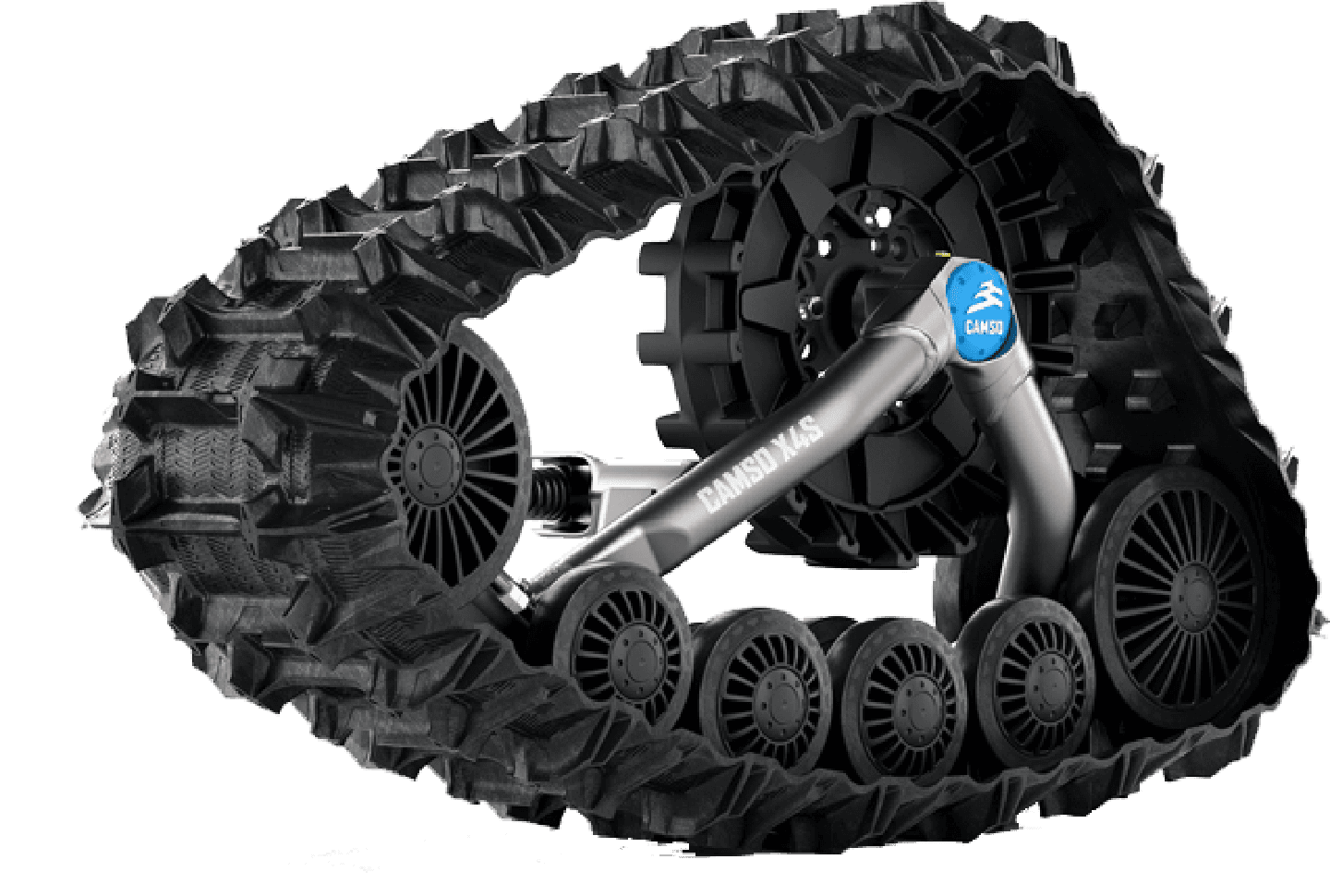
From $5,049
ATV & UTV
The default hunting pick. It is built as an all-season track rather than a snow-only one and it covers both ATVs and UTVs, so one system can serve a mixed camp across soft ground in October, snow in January, and plot access in April.
See Camso X4S fitments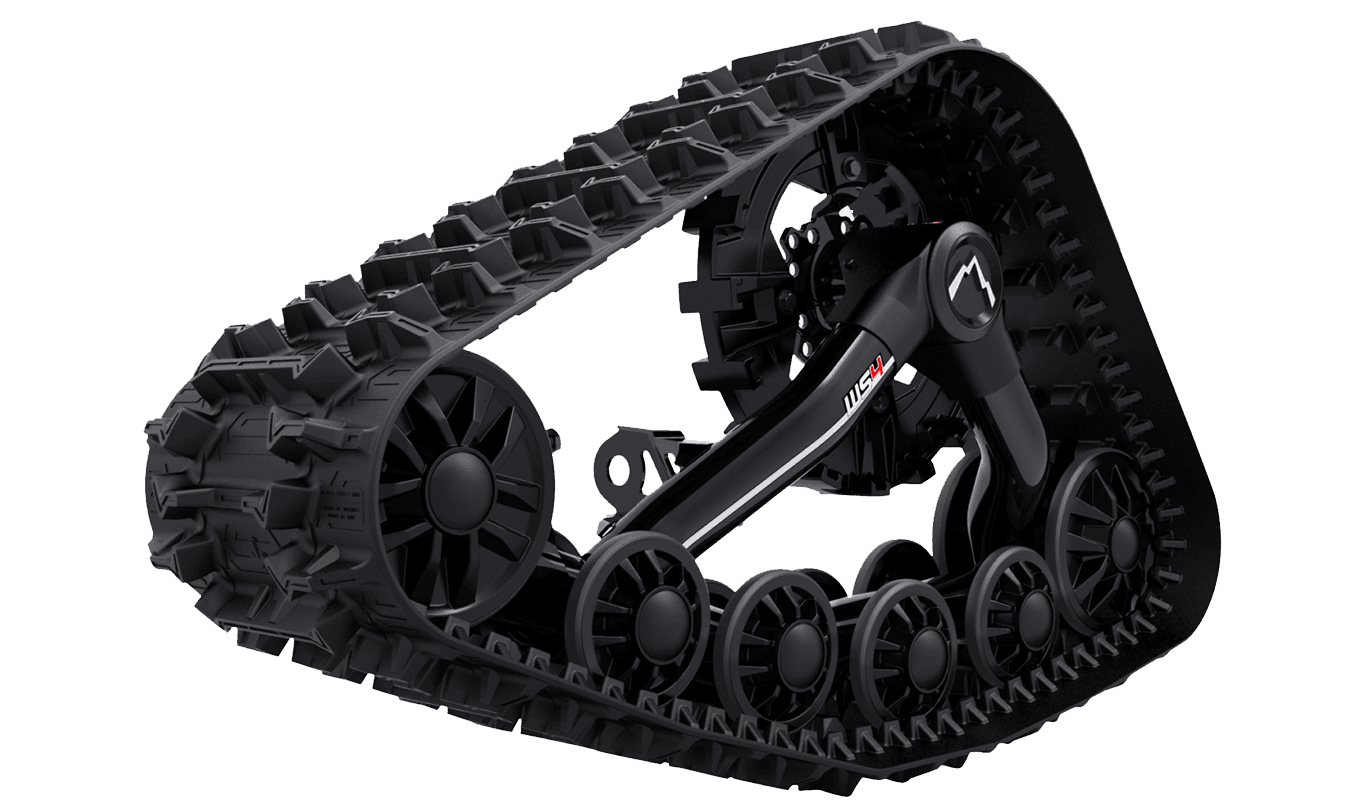
From $4,845
ATV
The one most likely to fit the quad you already own — 733 machine configurations, the widest ATV coverage we carry. Start here if this is your first set of tracks.
See Kimpex WS4 fitments
From $4,599
ATV
The cheapest way onto tracks. Sized for a hunter running a known route on packed snow or frozen ground, rather than breaking new trail with a load behind.
See Camso T4S fitmentsUTV / side-by-side track systems

From $5,995
UTV
Broad side-by-side coverage at 524 configurations, and the lowest-priced system we sell that is built specifically for side-by-sides. The Camso X4S starts lower but is an ATV-first system that also covers UTVs. Sized for a camp that moves two people, gear, and one animal at a time.
See Kimpex WSS4 fitments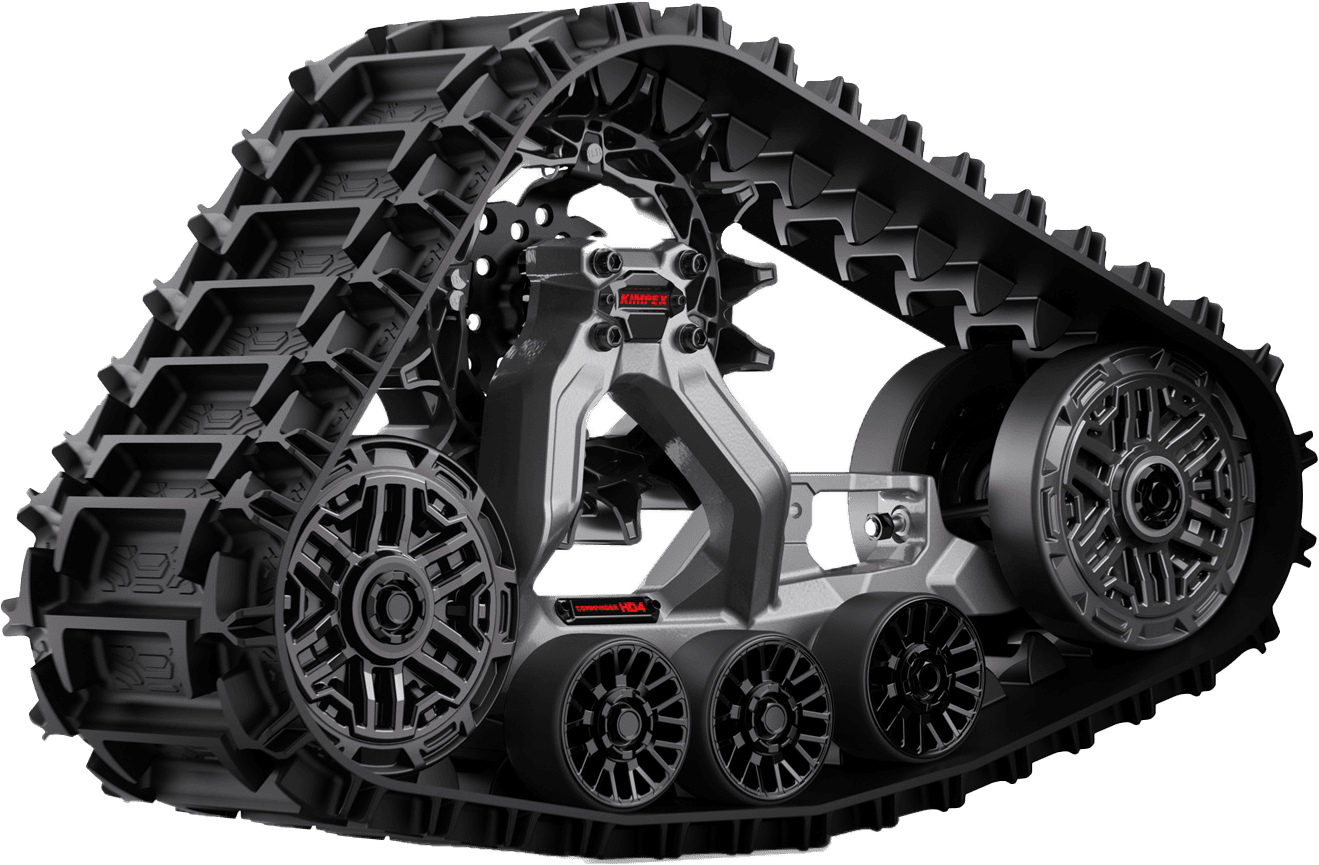
Kimpex HD4
Heavy DutyFrom $12,749
UTV under 4,000 lbs
Heavy duty, for side-by-sides under 4,000 lbs that work the property all year. Outfitters, western camps handling several animals a season, and property managers towing loaded implements are the ones who need this rather than the mid-range systems. It is a substantial step up in price.
See Kimpex HD4 fitmentsBefore opening morning
Most of this happens weeks ahead of the opener rather than the night before it.
1. Confirm motorized retrieval is legal in your unit
Pull the current motor vehicle use map for the national forest or BLM unit and read the state game agency regulations alongside it. Designated Wilderness is closed to motor vehicles and mechanical transport outright. Elsewhere, motorized travel is usually confined to designated routes, and a big-game retrieval exception is a local decision with limits on distance and season if it exists at all. Check this year, not last year.
2. Order early enough that a back-ordered kit does not cost you the opener
Tracks are matched to your exact year, make, and model, and each system needs its own install kit. Availability tightens as fall approaches, and some systems are pre-order with limited fitments. Confirm fitment and stock while there is still time to ship, install, and ride the machine once before the season.
3. Drive the route out before opening day
Pick the line you would take with a load, in daylight, weeks ahead. Find the two places that will stop you, which are almost always the wet crossing and the sidehill. A route that works empty at noon is a different route loaded at nine at night.
4. Check your rack or bed rating against the animal
Measure chest girth with a tape and use the chart above. Then look up the rated rack, cargo, and towing figures for your machine and work from those numbers. Tracks improve traction. They do not raise the manufacturer's ratings, and a mature buck is past the rear rack rating of a lot of common hunting quads.
5. Check tension in the cold, not in the shop
Tension set in a heated shop reads differently once the rubber is cold and stiff. Check tension and alignment against the spec in your system's manual, at the truck, in the conditions you will actually ride in, rather than in the garage the week before the opener. Chasing slack past the published figure over-tensions the system and loads the bearings and idlers instead.
6. Rig for dead weight, and for the dark
Two ratchet straps, a tarp or game bag, and a way to lift dead weight onto the rack alone: a come-along, or a winch run through a snatch block off a tree. Carry a bolt kit, spare sprocket bolts, the tools to use them, and a saw for blowdown. Bring a headlamp and a spare, since most of this work happens after dark with both hands busy. Tell someone which stand you are sitting and when you expect to be back at the truck.
Common questions
Can my ATV or UTV carry a whole deer out with tracks on?
Sometimes, and the limit is your machine's rated capacity, not the tracks. Check it before you count on it — a lot of ATVs cannot legally carry a mature buck on the rear rack. A Polaris Sportsman 570, one of the most common hunting quads, is rated for 180 lbs on the rear rack and 90 lbs on the front, and a 44-inch-girth buck field-dresses at 198 lbs. Side-by-side beds generally have far more room to work with. Per the Pennsylvania Game Commission chart above, a field-dressed whitetail ranges from about 26 lbs for a fawn to 272 lbs for the largest deer on the chart, with a mature buck of 40 to 44 inch chest girth landing between 144 and 198 lbs. Read the rack or bed rating on your own machine and work from that. Tracks do not raise it. What tracks change is whether you can move that load across saturated ground and snow instead of spinning in place.
How long before the season should I order tracks?
Early enough to absorb one thing going wrong. Track systems are fitment-specific and each one needs a matching install kit for your exact year, make, and model, so an order is not a single item off a shelf. Demand concentrates in late summer and fall, availability on individual kits moves, and some systems are pre-order with limited fitments — the Camso ENDUR is currently in that category. Plan to have the machine on tracks and ridden at least once before you need it, so that tension, alignment, and clearance are sorted on your own time rather than in the dark on opening morning. Call us with your machine and we will tell you what is actually in stock for it right now instead of guessing at a lead time.
Can I drive to my animal on public land?
It depends entirely on the unit, and the answer is more often no than hunters expect. Designated Wilderness prohibits motor vehicles, motorized equipment, and other forms of mechanical transport under the Wilderness Act, and that prohibition has been applied to wheeled game carts as well as machines. Outside Wilderness, national forest and BLM travel management plans typically confine motorized travel to designated routes shown on a motor vehicle use map. Some units publish a narrow game retrieval exception with a distance limit and a season; many publish none. The way to answer this for your hunt is to read the motor vehicle use map for the unit and the current state game agency regulations, not to assume from what was allowed somewhere else or last year. Tracks change what the machine can cross. They change nothing about where it is allowed to go.
Can I get an elk out in quarters on a tracked side-by-side?
That is the normal way it is done where motorized retrieval is permitted, and it is a bed-capacity and trip-count problem rather than a track problem. Quarter the animal, work from your machine's rated bed and towing figures, and plan on more than one trip to the trailhead rather than one heroic load. We do not publish an elk weight table because we have not found a state agency chart for elk we are willing to reproduce; use the numbers your own state wildlife agency publishes. For a sense of the upper end of large game, Alaska Department of Fish and Game tells moose hunters to expect 400 to 700 lbs of meat plus up to 65 lbs of antlers to move from the kill site, which is multiple trips or a trailer for any machine on this site. Confirm the unit allows motorized retrieval before you build the plan around it.
Are tracks quieter than tires on the way to a stand?
No. Tracks add mechanical noise from the sprockets, idlers, and lugs, so do not buy them expecting stealth. The access advantage is different and it is real: tracks let you park farther out and still reach the stand, and they let you take a creek bottom or field edge that keeps the machine downwind and out of the bedding area, instead of forcing you up the one hard-packed trail that runs through the middle of everything.
When in the season should I put tracks on?
Two windows drive it. The first is the wet stretch in early and mid fall, when saturated ground and standing water close the interior of a property to tires. The second is first snow. If you want one install a year, put them on before the ground freezes and leave them until spring thaw is finished. Expect a real speed penalty — Camso puts the average loss at about 30 percent, with some machines seeing up to 50 percent — along with higher fuel consumption, and note that most track systems are not intended for extended pavement travel.
Which system fits my machine?
Between Camso and Kimpex we cover most of what hunters drive. The Kimpex WS4 covers the widest ATV range we sell at 733 machine configurations. The Kimpex WSS4 covers 524 side-by-side configurations. The Camso X4S spans both ATVs and UTVs across 416. What fits is a function of your exact year, make, and model, and each system rides on its own install kit. Our find-what-fits tool will narrow it down, or give us the machine over the phone and we will confirm the kit before you spend anything.
Same machine, other jobs
More from the field
Watch
ATV Tracks in the woods
ATV in the woods in Deep Snow using Camso Tracks
EP01 | Hunting a mature buck with Jeff Sturgis
Not sure what fits your machine?
Tell us what you drive and how you use it. We will confirm the right track system and install kit before you spend a dollar.
(866)243-8359