






ATV & UTV Tracks for Land Management
Firewood, timber, trail work, and food plots happen on ground that does not stay firm. Tracks are how a machine keeps working after the ground turns soft, drifts over, or heaves with frost.
Four windows of woodlot work
The work does not reschedule itself around the ground. These are the four stretches of the year when the ground is the thing standing in the way.
Ground that will not hold a tire
Tracks spread the machine and its load across far more surface area than four tires. Skid trails, wet swales, and thawing landings that stop a wheeled machine stay passable.
Fewer ruts to repair later
A rut in a skid trail is not just a rough ride. It channels water, and the trail erodes every time it rains until someone goes back and fixes it. Spreading the same load over more ground is how you avoid that second job.
Work the wet weeks
Firewood, trail repair, and plot work fall in the parts of the year when the ground is worst. The wood gets cut in October and burned in January, and the culvert washes out in April. Tracks are what keep those weeks from being lost.
Through the season
Late summer
Food plots and clearing
Discing, spraying, and hauling seed and lime to plots at the end of a two-track. The wet swale or the beaver flowage crossing is usually the stopping point, and it is where a larger contact patch earns its cost. Preparing a plot and reaching a remote plot in season are two different problems — our hunting section covers the second one.
Late fall
Firewood cutting
The heaviest hauling of the year lands on wet, unfrozen ground, before the freeze firms it up. Wood cut green weighs the most it ever will, and one cord does not move in one trip. Work the trip count off the table below rather than off how the pile looks.
Winter
Skidding and timber work
Frozen ground is the best time to move logs, and deep snow is what keeps you from reaching them. Tracks hold the skid trail open between storms and keep a line across side slope where tires wash out downhill. Buck the long stems shorter and winch the grades rather than driving them.
Spring
Mud season, culverts, and water bars
Road and trail maintenance is its own job, not a footnote to logging. Cleaning a plugged culvert, cutting in a water bar above a washed grade, and pulling blowdown off the access road all fall in the weeks when the ground carries nothing. Sugarbush work — tap lines and sap hauling — lands in the same stretch.
How much does that firewood actually weigh?
Green wood is the number people get wrong. A cord is 128 cubic feet of stacked wood and air, and a full-size pickup bed loaded level with the rails holds about 64 cubic feet, roughly half of one. Half a cord of green white oak is therefore about 2,790 pounds of wood before you add the saw, the fuel, and yourself. The table below gives the published weight of a cord of each species freshly cut and after air drying, alongside the heat a dry cord returns for hauling it. Read the green column against the bed and towing ratings in your owner's manual, then count trips.
Weight and heat value of a cord, by species
| Species | Green weight (lb per cord) | Air-dried weight (lb per cord) | Heat per cord, dry wood (million BTU) |
|---|---|---|---|
| Apple | 4,850 | 3,888 | 27.0 |
| Ash, Green | 4,184 | 2,880 | 20.0 |
| Ash, White | 3,952 | 3,472 | 24.2 |
| Basswood (Linden) | 4,404 | 1,984 | 13.8 |
| Birch | 4,312 | 2,992 | 20.8 |
| Boxelder | 3,589 | 2,632 | 18.3 |
| Buckeye, Horsechestnut | 4,210 | 1,984 | 13.8 |
| Catalpa | 4,560 | 2,360 | 16.4 |
| Cherry | 3,696 | 2,928 | 20.4 |
| Coffeetree, Kentucky | 3,872 | 3,112 | 21.6 |
| Cottonwood | 4,640 | 2,272 | 15.8 |
| Douglas-fir | 3,319 | 2,970 | 20.7 |
| Elm, American | 4,456 | 2,872 | 20.0 |
| Elm, Siberian | 3,800 | 3,020 | 20.9 |
| Fir, White | 3,585 | 2,104 | 14.6 |
| Hackberry | 3,984 | 3,048 | 21.2 |
| Honeylocust | 4,640 | 3,832 | 26.7 |
| Juniper, Rocky Mountain | 3,535 | 3,150 | 21.8 |
| Locust, Black | 4,616 | 4,016 | 27.9 |
| Maple, Other | 4,685 | 3,680 | 25.5 |
| Maple, Silver | 3,904 | 2,752 | 19.0 |
| Mulberry | 4,712 | 3,712 | 25.8 |
| Oak, Bur | 4,960 | 3,768 | 26.2 |
| Oak, Red | 4,888 | 3,528 | 24.6 |
| Oak, White | 5,573 | 4,200 | 29.1 |
| Osage-orange | 5,120 | 4,728 | 32.9 |
| Pine, Ponderosa | 3,600 | 2,336 | 16.2 |
| Redcedar, Western | 2,950 | 2,632 | 18.2 |
| Spruce | 2,800 | 2,240 | 15.5 |
| Sycamore | 5,096 | 2,808 | 19.5 |
| Walnut, Black | 4,584 | 3,192 | 22.2 |
| Willow | 4,320 | 2,540 | 17.6 |
Published averages for one cord, an evenly stacked pile of 128 cubic feet of wood and air. The BTU column is the source figure for dry wood only. Highlighted rows are the five heaviest green loads in the table, which are the species that decide how many trips a job takes. Only the species that publish both a green and an air-dried figure are reproduced; the source leaves the rest blank and we have not filled them in. Source: Utah State University Forestry Extension, "Wood Heating" (Table 1, Firewood Facts)
What a single log weighs
Skidding is decided one stem at a time. University of Tennessee Extension publishes average log weights for mixed hardwoods — red and white oak, hickory, and yellow poplar. Diameters below are scaling diameter, measured inside the bark at the small end of the log, and lengths exclude trim. Measure the butt end or measure over the bark and you will land several rows up the table and underestimate the load.
| Log size (scaling diameter by length) | Average weight (tons) | Approximate pounds |
|---|---|---|
| 12 in. by 8 ft | 0.23 | 460 lb |
| 16 in. by 12 ft | 0.61 | 1,220 lb |
| 20 in. by 16 ft | 1.30 | 2,600 lb |
Averages only. SP 748 states that even for logs of the same diameter, weights for individual logs can range plus or minus 40 percent of the average value. The Table 2 data is adapted from Timson (1972) for white and red oaks, yellow poplar, and hickory sampled in West Virginia, Virginia, and Maryland. The 20-inch row is marked as a caution rather than a target: 2,600 pounds is past what an ATV or side-by-side should be dragging, and it should be bucked shorter or left for a machine built for it. Source: University of Tennessee Extension SP 748, "Estimating Weight of Logs and Standing Timber" (Table 2)
Seasoning does not halve the weight
Utah State notes that green firewood may hold 50 percent or more water by weight. That figure is the moisture content of green wood, not the drop between these two columns — air-dried wood still carries roughly 20 percent moisture. The real column-to-column drop runs nearer 20 to 30 percent for most species: white oak falls from 5,573 to 4,200, red oak from 4,888 to 3,528, spruce from 2,800 to 2,240. Plan a load off the green column, not the dry one. The green column is also the weaker half of the source data. White ash, for example, is listed lighter green than green ash despite being the heavier of the two dry. Treat every figure here as a planning number with real spread around it, and weigh an actual load if the number decides whether you are inside your machine's rating.
A cord, a face cord, and a thrown pile are three different loads
A cord is an evenly stacked pile containing 128 cubic feet of wood and air space. A face cord is 4 feet high, 8 feet long, and as deep as the pieces are long, which works out to roughly 32 to 48 cubic feet — so a face cord is a fraction of a cord, not a synonym for one. Separately, Utah State notes that a randomly piled stack generally contains more air and less wood than one neatly piled, so two loads of the same volume can differ in weight. For scale, a full-size pickup with a standard bed holds about half a full cord, or 64 cubic feet, when loaded even with the top of the bed.
Tracks change traction, not your rated capacity
Bed capacity, tongue weight, towing capacity, and gross vehicle weight rating come from the manufacturer and do not change when you bolt on tracks. One thing moves against you: a track system weighs considerably more than the wheels and tires it replaces, and that added weight counts against gross vehicle weight rating, leaving you less payload than you had on tires. Most systems also sit the machine higher than tires do, which raises the center of gravity before you load a single round. Stay inside the manual's numbers, subtract the tracks, and keep the heaviest pulls straight up or straight down the grade rather than across it.
Which track system?
What you drag matters more than what you drive. Size the system to the heaviest load the machine will pull, not the average one.
ATV track systems
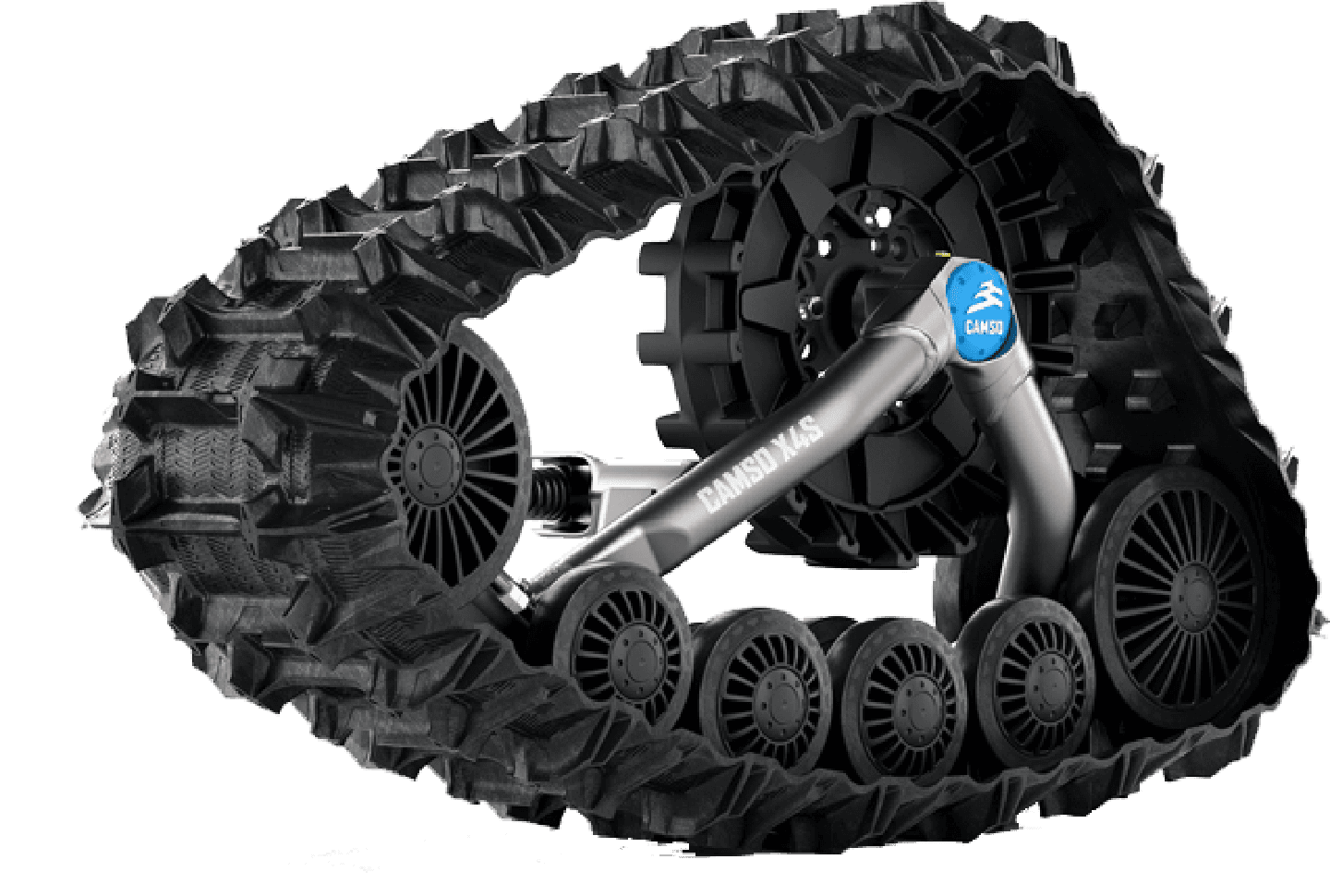
From $5,049
ATV & UTV
One system that fits both an ATV and a side-by-side. The sensible choice when the tracks go on in March and come off in May of the following year, if at all.
See Camso X4S fitments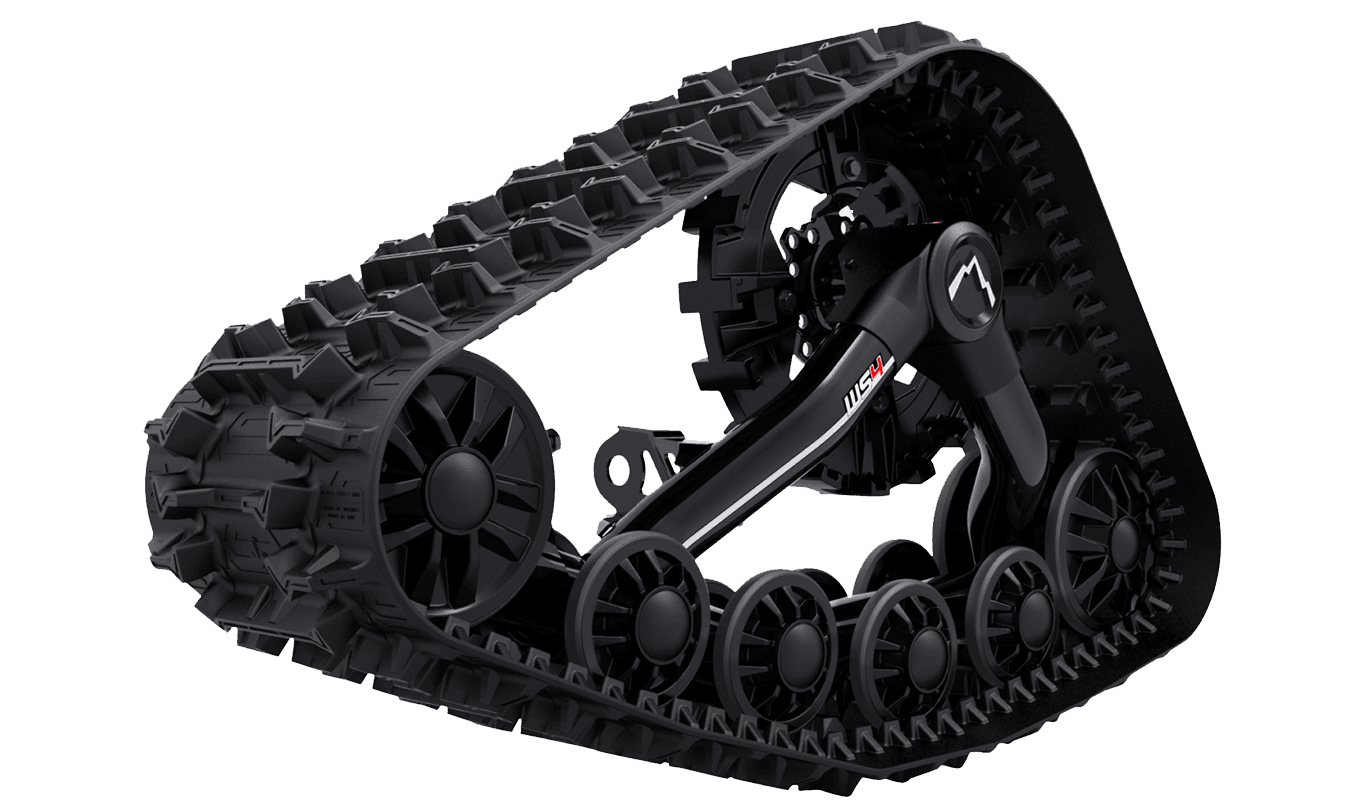
From $4,845
ATV
The widest ATV fitment we carry, and the usual answer for a landowner cutting firewood off a quad rather than a side-by-side.
See Kimpex WS4 fitmentsUTV / side-by-side track systems
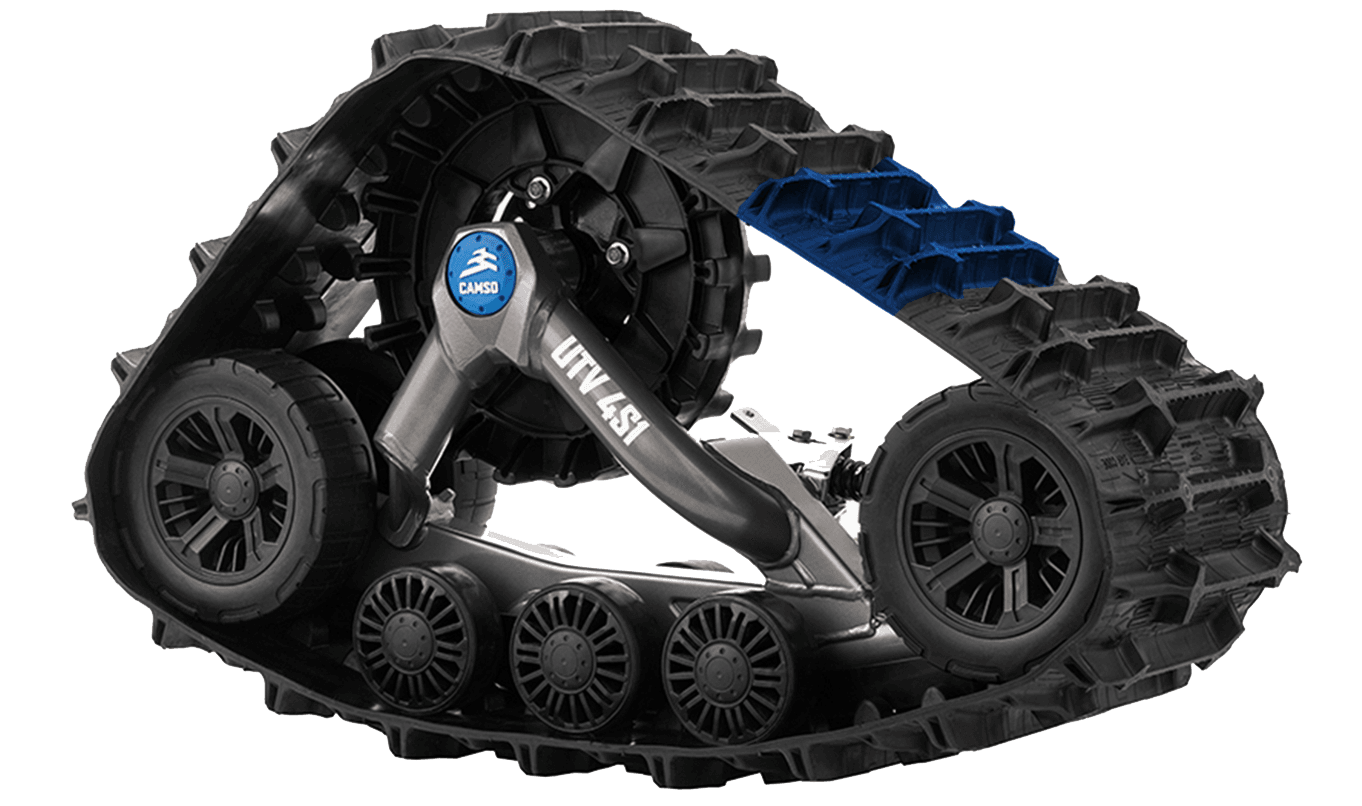
From $6,599
UTV, ATV & 4x4
The first pick for a side-by-side that carries a bed of green wood and pulls a trailer behind it. Fits UTV, ATV, and 4x4 platforms, so one system covers a mixed equipment shed.
See Camso 4S1 fitments
From $5,995
UTV
Broad side-by-side coverage for general property access — plot runs, checking gates and culverts, and firewood loads that stay inside the bed rails.
See Kimpex WSS4 fitments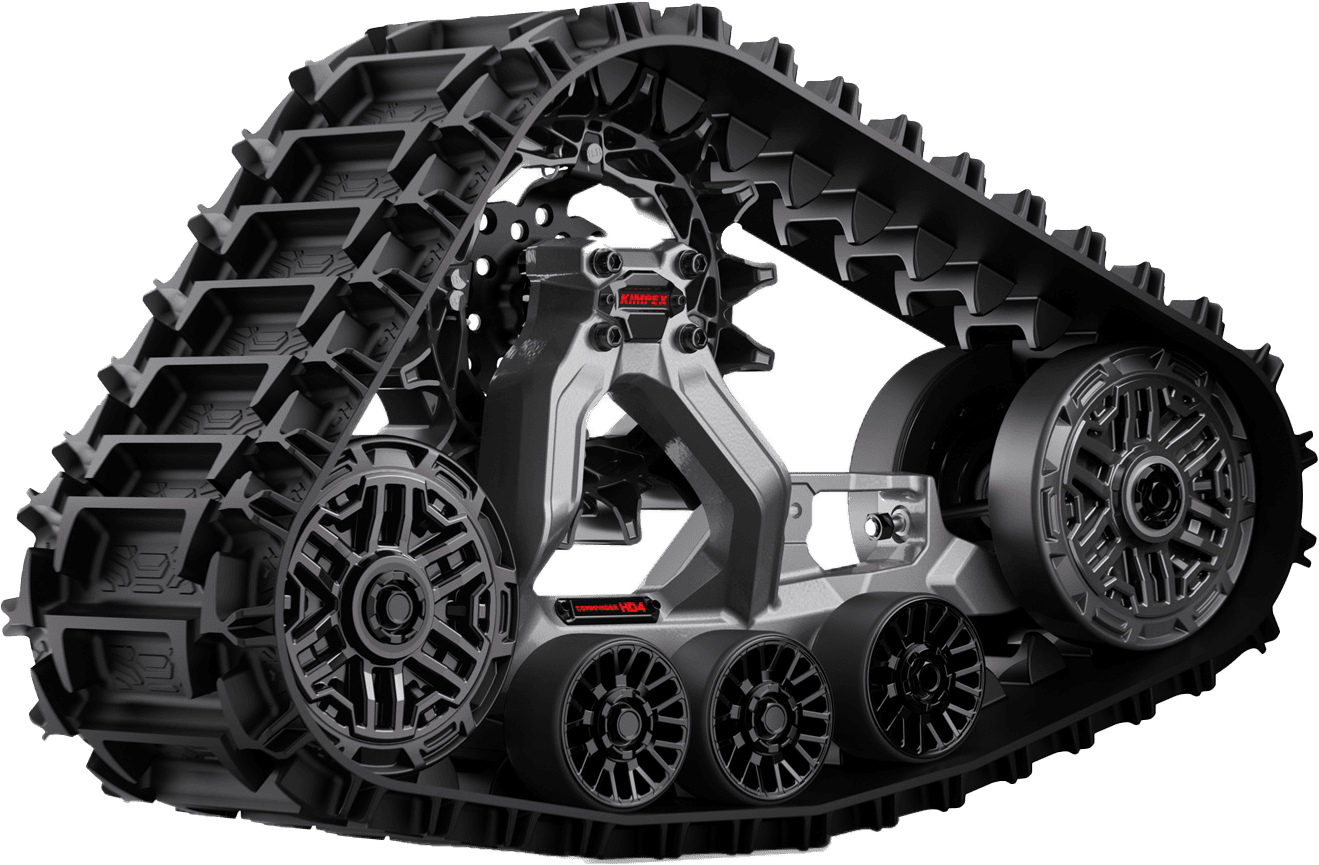
Kimpex HD4
Heavy DutyFrom $12,749
UTV under 4,000 lbs
Reinforced components for a side-by-side under 4,000 lbs that tows a loaded log trailer most weekends and works a grade doing it.
See Kimpex HD4 fitmentsBefore a day in the woods
Once the saw is running you are a long way from the tailgate. This is the part to settle before that happens.
1. Convert the pile into pounds
Use the table above. Multiply the green weight per cord by the fraction of a cord you intend to move, then divide by what your machine is rated to carry. That is the minimum number of trips, and it is usually higher than the one in your head. Bed volume often runs out before the weight rating does, so treat the weight answer as a floor rather than a plan.
2. Read the ratings, then subtract the tracks
Bed capacity, tongue weight, and towing capacity are printed in your owner's manual and they do not change when you install tracks. A track system does weigh more than the wheels and tires it replaces, and that weight counts against gross vehicle weight rating, so the payload left to you is smaller than it was on tires. Work from the manual, take the tracks off the top, and include the weight of the trailer itself.
3. Pick the route before the first loaded trip
Walk the skid trail empty and find the stumps, the wet spots, and the side slope while there is nothing in the bed. A loaded machine on a cross slope handles like a different vehicle. Route around the wettest crossing rather than through it, even if it costs you distance, and decide where you will turn around before you need to.
4. Clear the sprockets and check tension
Packed mud, bark, and ice in the drive sprockets are a woodlot problem more than a snow problem, and a slack track derails under load exactly when you are furthest from the truck. Check tension, alignment, and the anti-rotation brackets with the machine empty, and clear the sprockets again before the loaded trip back.
5. Load low and toward the front
Stack inside the bed rails and keep the heaviest rounds against the bulkhead. Wood piled high raises the center of gravity on the same slopes you already have to cross. Tracks give you no extra rollover margin, and most systems sit the machine higher than tires do, which raises the center of gravity before you load a single round.
6. Pack the recovery and saw kit
A winch, a snatch block, a tree-saver strap, a choker chain rated above the loaded weight, and a throw line for hung limbs. Add felling wedges, a spare saw chain, bar oil, saw fuel, chaps, a spare bolt kit for the track system, and a first aid kit. Tell someone which block you are working and when you expect to be out of the woods.
Common questions
How much does a cord of firewood weigh?
It depends on species and how green it is, and the spread is wide. Utah State University Forestry Extension lists a cord of green white oak at 5,573 pounds against 4,200 pounds air-dried, green red oak at 4,888 pounds against 3,528 dry, and green spruce at 2,800 pounds against 2,240 dry. The gap is water. Utah State notes green firewood may hold 50 percent or more water by weight, but air-dried is not bone dry — it still carries roughly 20 percent moisture, so the drop from the green column to the dry column is smaller than that 50 percent figure suggests: about 25 percent for white oak and 20 percent for spruce. A cord is 128 cubic feet of stacked wood and air, so no ATV and no side-by-side moves one in a single trip. Use the table on this page to work out how many trips the job really takes.
Can I skid logs with an ATV or UTV on tracks?
Within limits, and the limits are heavier than most people guess. University of Tennessee Extension publishes average log weights for mixed hardwoods — red and white oak, hickory, and yellow poplar. Diameters are scaling diameter, measured inside the bark at the small end of the log, and lengths exclude trim. A 12-inch by 8-foot log averages 0.23 tons, about 460 pounds. A 16-inch by 12-foot log averages 0.61 tons, about 1,220 pounds. A 20-inch by 16-foot log averages 1.30 tons, about 2,600 pounds, which is past what these machines should be dragging. Individual logs of the same diameter run plus or minus 40 percent from those averages. Buck long logs shorter, use a log arch to lift the leading end out of the dirt, and winch on grades rather than driving through them.
Do tracks tear up a skid trail more than tires?
On soft ground tracks generally do less damage, because the same weight is carried on a much larger contact patch and sinks in less. The trade is at the surface. Tight turns scuff sod and duff more than a tire does, so make wide turns near landings, plots, and lawns. No track system makes a saturated trail immune to damage. If water is standing in the rut behind you, the trail is finished for the day no matter what you are running — and a rut that channels water is what turns one day of hauling into a season of erosion repair. Surface rutting is the woodlot version of this question; the subsurface version, compaction on pasture and hay ground, is covered on our ranching and farming page.
Can I run a disc, sprayer, or drag with tracks on?
Usually yes for towed implements, with two things to check first. Tracks raise the machine, so hitch height changes and a drawbar that sat level on tires may now pull nose-down. Ground speed also drops, which matters for anything calibrated per acre — a sprayer set up on tires will over-apply at track speed unless you recalibrate. Front-mounted and machine-mounted implements are the harder case, because the track system occupies the space the mount was designed around. Check the specific implement against your specific track model before you buy either one, and call us if you cannot find the clearance figures.
Can I plow with tracks on?
Many blades and blowers can be run with tracks, but the added ride height changes plow geometry and not every mount clears a track system, so check your plow against your specific track model before winter. Beyond fitment, plowing is its own subject — blade width, surface, and how a tracked machine behaves pushing snow rather than carrying wood. Our snow removal section covers that side properly rather than us summarizing it here.
Can I use a tracked machine on a fire line or prescribed burn?
Tracked side-by-sides are used on fire lines for the same reason they are used on skid trails: they carry a pump, a tank, and hand tools across ground that a wheeled truck cannot reach, and they leave a shallower rut doing it. What tracks do not do is make a fire line safe. Escape routes, safety zones, holding assignments, and burn plan conditions govern that, and a track system changes none of them. Rubber tracks are also combustible, so keep the machine on cold black or outside the line rather than parking it in fuel. If you are buying for a district, department, or agency, our GSA-approved page covers agency and district purchasing.
Which track system fits a woodlot machine?
Camso and Kimpex between them cover thousands of ATV and UTV configurations, and which one fits comes down to your exact year, make, and model. Each system also needs its own install kit, which is what actually mates the track to your hubs. Our fitment tool will tell you what mates to your hubs, or call us with the model and the heaviest load you plan to pull and we will tell you which system to be looking at.
Same machine, other jobs
Not sure what fits your machine?
Tell us what you drive and how you use it. We will confirm the right track system and install kit before you spend a dollar.
(866)243-8359