






Kimpex
In stock
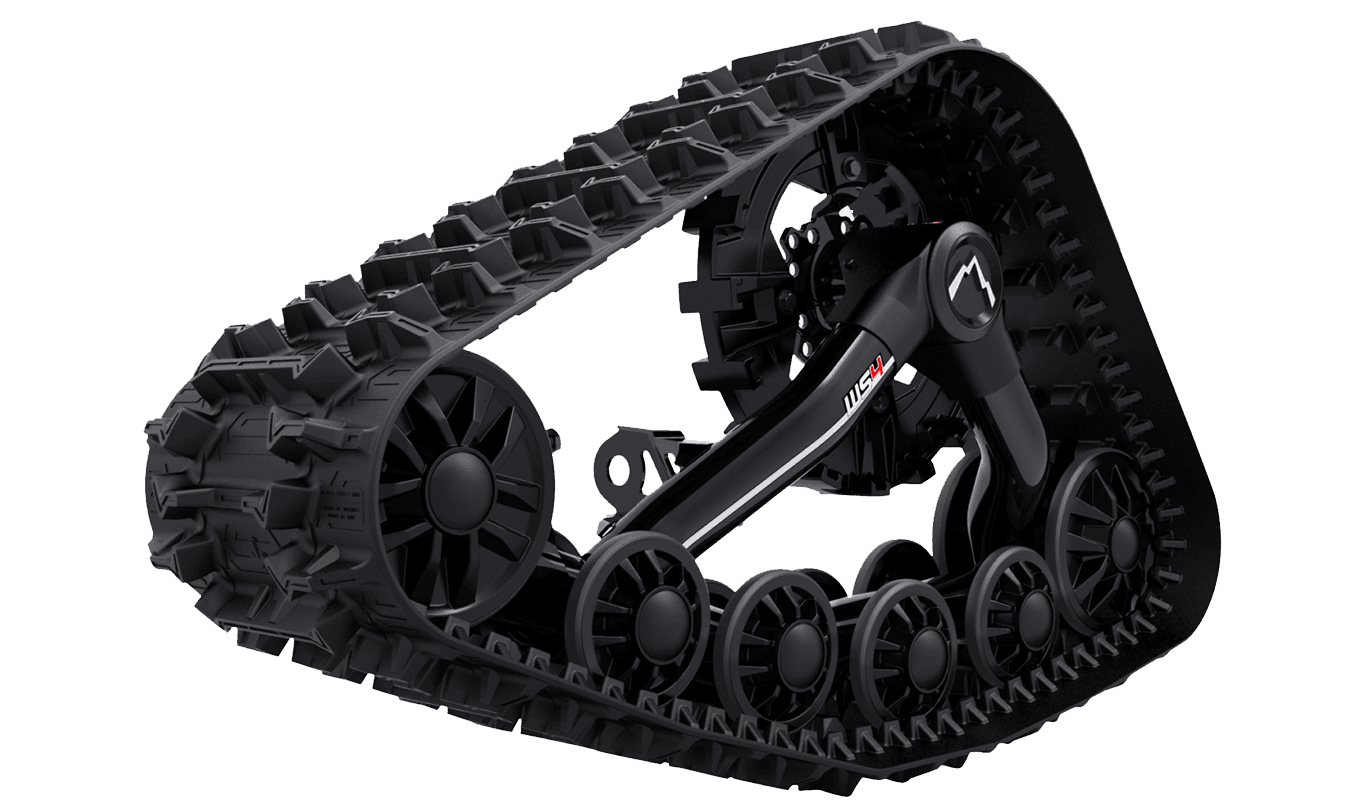
Kimpex WS4
$4,845
All-around · kit price for this machine
- Published Rancher applications
- 24
- Model years
- 2007–2025
Fits Rancher 420.
Built for clearing driveways, properties, and real winter work
Camso & Kimpex · Authorized dealer
Almost every published Rancher application is a 420, and the thing that decides which kit you order is not the trim, the transmission or the year — it is whether the machine has a rigid rear axle or independent rear suspension. Camso publishes two separate 420 kits on exactly that split, and Honda sold both side by side for a decade.

Verified fitment
Read down to your trim, then across to see which systems we can actually supply a kit for. 36 applications across 3 trims, taken from our own catalog rather than from engine size — a machine is on this table because a kit is published for it, not because it looks like one that is.
The Rancher 420 row carries both “Rear Rigid Axle” and “Rear Independent Suspension” qualifiers, which is why no single suspension type is printed against it. Those are two different Camso kits. Camso also marks both 420 rows with remark K, “temporary vehicle modification”.
Scroll the table sideways to see every system.
Pick your year, then your exact Honda Rancher. These are the 3 systems with published Honda Rancher fitment.
Year
The shortlist
Coverage first, price second. The counts below are this machine's own published applications, not the system's catalog-wide total, so a system that fits one trim of yours cannot look like one that fits all of them.
$4,845
All-around · kit price for this machine
Fits Rancher 420.

$4,599
All-around · kit price for this machine
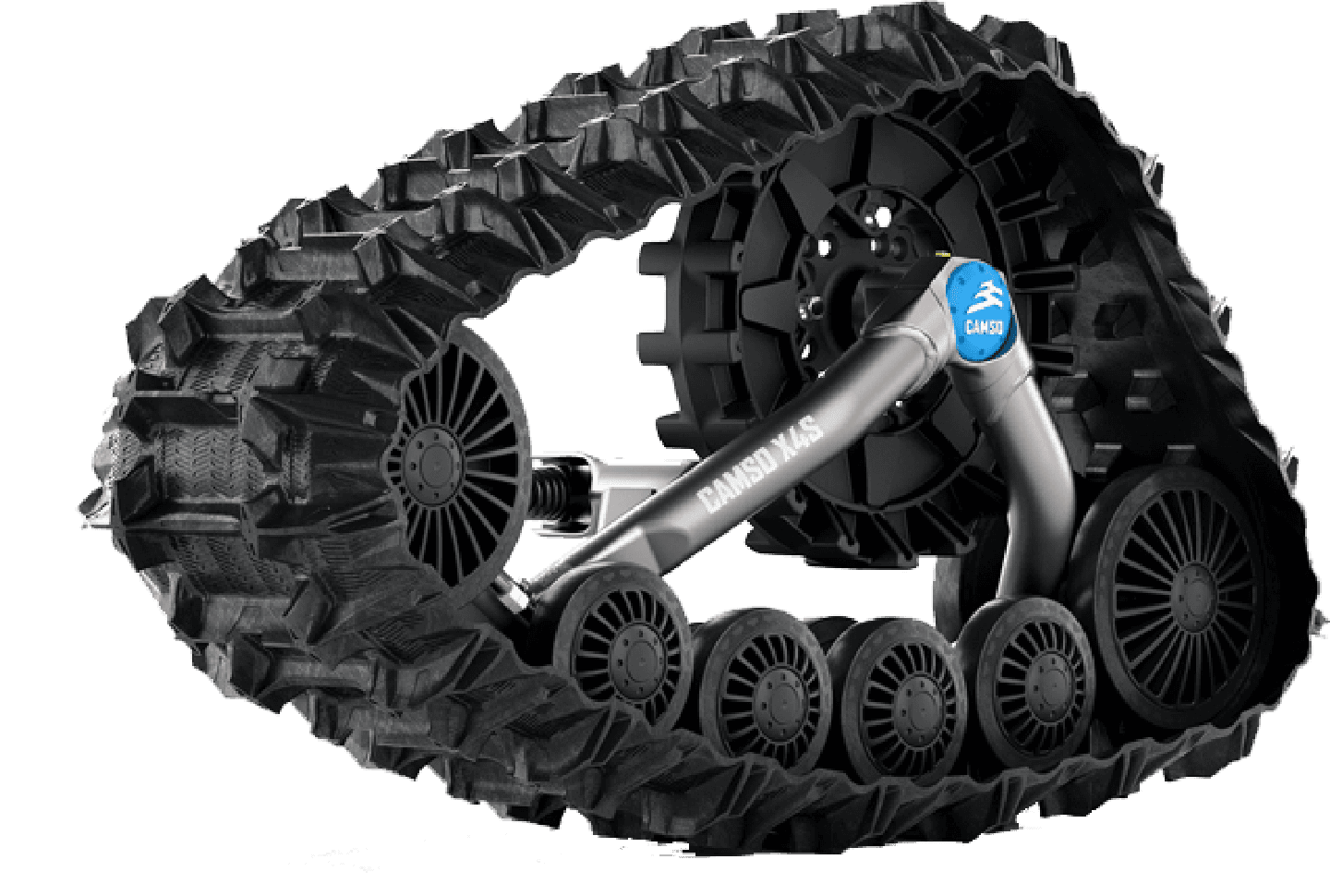
Fits Rancher 420, Rancher 400 and Rancher 350.
$5,049
All-around · kit price for this machine
Fits Rancher 420, Rancher 400 and Rancher 350.
Quoted from Camso and Kimpex, not converted or re-measured. The two companies do not measure ground coverage the same way and neither says how, so read those figures against each other with care.
| Specification | Kimpex WS4 | Camso T4S | Camso X4S |
|---|---|---|---|
| Manufacturer rating | ATV only, four seasons | All-terrain, 300 to 1000cc | ATV 300 to 1000cc, side-by-side 400 to 700cc |
| Ground coverage | 1.32 m² (2,045 sq in) flotation surface | approx. 2,000 sq in ground coverage | approx. 2,000 sq in ground coverage |
| Lug height | 25 mm (1 in) front / 32 mm (1.25 in) rear | 1.125 in front / 1.25 in rear | 1.125 in front / 1.25 in rear |
| Speed loss vs tires | 35% | Average about 30%, and up to 50% on some vehicles | Average about 30%, and up to 50% on some vehicles |
| Frame | Triangulated steel, 2.5 in (64 mm) tubing | Carbon steel | Carbon steel |
| Warranty | 1 year, plus 1 additional year on registering the product | 2-year limited, valid when the system is installed by an authorized Camso dealer | 2-year limited, valid when the system is installed by an authorized Camso dealer |
Sources, read 30 August 2026: Kimpex WS4 · Camso T4S · Camso X4S.
What actually differs
The track units are the same product on every machine they fit. What is specific to yours is the hardware that attaches them and the gearing that drives them — which is why fitment is published per trim and per year rather than per engine size.

Honda built the TRX420 both ways. Camso publishes a separate application for each: one marked “Rear Rigid Axle” and one marked “Rear Independent Suspension”, both covering 420 Foreman and Rancher machines, both with 16-tooth sprockets front and rear. The catalog carries the same split. If you order against displacement alone you have a coin-flip chance of getting the wrong one, and the model code on the machine is the fastest way to settle it — a TRX420FA5 or FA6 is an IRS machine, an FM1 or FE1 is not, but check with us rather than against that sentence.
Every Camso Rancher row in the catalog is titled “TRX Foreman / Rancher” — the 350 from 1994, the 400 from 2004, and the two 420 variants that run to 2025. One application, two model families. Kimpex takes the opposite approach and lists 24 separate Rancher applications by model code, from TRX420FA to TRX420TM1. Same machine, two ways of describing it, which is why the table above is built from the catalog rather than from either manufacturer’s naming.
Remark K in Camso’s application guide is defined in its own legend as “temporary vehicle modification”, and it is set against both the rigid-axle and the independent-rear 420 Foreman / Rancher rows. Camso does not publish what has to be modified or for how long. That is a question worth asking before the kit arrives rather than while it is on the bench, and it is one of the few conditions Camso flags anywhere on the Honda line.
In use
The Rancher is the smallest-displacement family on this side of the site, and tracks are bought for it to keep working rather than to go faster. Kimpex publishes 2,045 square inches of flotation surface for the WS4.
Kimpex lists marshland, mud, sand, dirt road and gravel for the WS4 alongside its snow ratings. Both manufacturers sell these as all-season systems.
Kimpex publishes 30 minutes to swap between tracks and wheels once the vehicle-side hardware is fitted.
Ownership
What ships, what the install involves, and what you will be buying again in a few seasons.
A Camso kit is four track systems plus the mount kit adapted to your machine, on one line. A Kimpex Commander install is separate line items: the track kit, then the adapter for your machine, then the anti-rotation hardware.
On this machine the full code — TRX420FA6, TRX420FM1 and so on — is what separates the independent-rear applications from the rigid-axle ones, and Kimpex catalogues its 24 Rancher applications by exactly that code. It is stamped on the frame and on the compliance label.
Kimpex publishes 1.5 hours for a first WS4 installation and 30 minutes for each subsequent swap. Camso’s two-year limited warranty is stated as valid when the system is installed by an authorized dealer. Kimpex publishes two different Commander warranty terms — three years on its microsite, one year plus one on registration on its US warranty page.
The previous version of this page said to check tension before every ride because the Rancher’s lower power made it matter more. Neither manufacturer publishes anything of the kind. Camso publishes an exact tension figure — a set deflection under a set force — in the manual that ships with the kit. Set it to that and follow the manual’s interval.
Bearings, hubs, sprockets, tread and tensioners, searchable by the serial number on your unit.
Open parts & service→Transfer kits adapt a set you already own to a different chassis. Which parts you need depends on both machines, so check the pairing before you sell the Rancher.
Open transfer kits→Have your year, trim and VIN ready — on a Rancher the trim and the model year are what decide the kit, not the engine size.
Ask us about your machine→Questions
All three ATV track systems publish applications for it, which is the only part of that question we can answer from a source. The old answer speculated about steep hills and deep snow versus bigger machines; that was not published by anyone. What is published is the speed loss — 35% for the Kimpex WS4, about 30% on average for Camso — and it applies to every machine, not just the small ones.
Nothing that either manufacturer publishes. Kimpex catalogues the DCT machines as their own applications by model code — TRX420FA1, FA2, FA5, FA6 — so the transmission is part of how the kit is identified, but no separate hardware or setting is published against it. The old claim that DCT “adapts well to the different resistance profile of tracks” was not sourced and is gone.
It is remark K, and Camso defines it in the legend of its own application guide as exactly that phrase and nothing more. It is set against both 420 Foreman / Rancher rows. Camso does not publish what is modified or how, and we are not going to invent it. Raise it with us when you order and we will chase the detail rather than guess at it.
People do, and both manufacturers photograph their ATV systems with a blade fitted. What we will not tell you is that the combination is trouble-free on a 420 — front-end weight and your plow mount’s clearance against the track units are real things to check, and neither manufacturer publishes a combined rating. Bring us the plow model along with the machine and we will look at the clearances.
They are there — the table shows a 350 and a 400 as well. Camso publishes a 350 TRX Rancher back to 1994 and a 400 TRX Foreman / Rancher from 2004, both with 15-tooth sprockets and both rigid rear axle. Kimpex publishes neither, so on those two machines Camso is the only published route.
Have your model year and trim to hand — on this machine those two are what decide the kit. We will tell you what is published for it and what is not.